
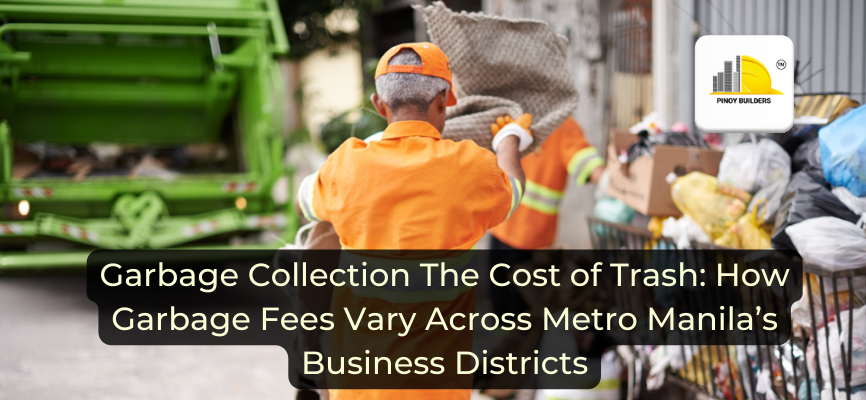
As urban centers expand across the country, industry experts stress that sustainable business operations begin with strategic waste management planning. From volume estimation to LGU compliance and haulage logistics, understanding the true cost of trash is a critical operational step that can determine a project’s long-term financial viability.
In the Philippine context, garbage fee assessment is a complex dance between local government revenue codes, Department of Environment and Natural Resources (DENR) mandates, and the unique logistical challenges of a congested metropolis. Here is the “Waste Economics 101” blueprint for navigating garbage fees in Metro Manila.
What Makes a Business “Waste-Ready”
While daily pickup is the primary goal, experts stress that efficient waste management requires much more than just a bin on the curb. Ideal commercial sites must meet several regulatory and technical conditions, including proper waste segregation areas, designated collection points, and compliance with the city’s specific characterization standards.
Access to reliable hauling services remains one of the most decisive factors. Even a prime office location can become problematic if LGU collection is inconsistent or if private haulage interconnection is too costly. Zoning classifications whether a business is categorized as a “heavy” or “light” waste generator are also essential to ensure accurate fee assessments and avoid the heavy penalties associated with under-declaration.
Balancing Environment and Development
Environmental compliance is another major consideration for modern builders. Developers are required to integrate Materials Recovery Facilities (MRF) and composting systems into their building plans to minimize the volume of residuals sent to landfills. Environmental impact assessments help ensure that commercial projects support city-wide “Zero Waste” goals without disrupting local sanitation ecosystems or neighboring communities.
Local government coordination is equally crucial. Early engagement with LGUs during the permit application phase helps streamline fee calculations, resolve classification conflicts, and align business waste protocols with regional solid waste management plans.
Garbage Collection Fee Schedule by City
To provide a concrete perspective on the “complex dance” of revenue codes, below is a breakdown of the garbage collection fees and calculation models for major cities in Metro Manila as of 2026.
1. City of Manila
- Status: Updated under Ordinance No. 9151 (Effective Jan 2026).
- Basis: Fees are determined by business category, floor area, and waste volume.
- Sample Rates:
- Small Clinics / Shops: Approximately PHP 12,000.00 annually.
- Banks (Main Office): PHP 1,375.00 quarterly.
- Amusement Places: Up to PHP 30,000.00 per quarter for large establishments.
- Hospitals: Ranges from PHP 275.00 (<100 sqm) to PHP 1,925.00 (>1,000 sqm) quarterly.
2. Quezon City
- Status: Follows a fixed regulatory fee schedule.
- Basis: Fixed annual fee based on business type.
- Sample Rates (Annual):
- Hotels / Motels: PHP 1,000.00
- Repair / Welding Shops: PHP 1,000.00
- Restaurants / Fast Food: PHP 800.00
- Private Schools: PHP 800.00
3. Mandaluyong City
- Status: Detailed in the Revised Business Tax Code.
- Basis: Specific rate per item (e.g., per table, per lane) or fixed annual fee.
- Sample Rates:
- Night Clubs: PHP 1,375.00
- Cinemas (>2,000 seats): PHP 825.00
- Bowling Alleys: PHP 55.00 per lane.
- Billiard Halls: PHP 13.75 per table.
4. Taguig City
- Status: Based on the Environmental Impact Fee (Ordinance No. 111-2007).
- Basis: Primarily based on floor area (square meters).
- Sample Rates:
- General Business (<100 sqm): PHP 75.00 per sqm.
- Hotels: PHP 250.00 – PHP 400.00 per room depending on classification.
- Amusement Centers: PHP 200.00 per machine.
5. Parañaque City
- Status: Updated Revenue Code (Ordinance No. 24-12, Effective 2025).
- Basis: Capitalization (for small/medium) and Estimated Waste Cost (for large).
- Sample Rates:
- Small Business (<P30k Capital): PHP 750.00
- Medium Business (P100k – P500k Capital): PHP 1,500.00
- Large Business (>P1M Capital): 0.3% of estimated annual waste cost.
6. Las Piñas City
- Status: Based on City Revenue Code.
- Basis: Fixed rates based on business category.
- Sample Rates:
- Retailers: PHP 500.00 – PHP 1,000.00
- Banks: PHP 1,500.00 – PHP 2,500.00
- Shopping Malls: PHP 15,000.00
| City | Fee Model | Estimated Cost (Small-Medium Biz) |
| Manila | High (New 2026 Ordinance) | P12,000 – P30,000+ / year |
| Quezon City | Fixed/Flat (Regulatory) | P800 – P1,000 / year |
| Taguig | Area-Based (Per Sqm) | ~P75 per sqm |
| Mandaluyong | Itemized (Per Unit/Facility) | Varies (e.g., P1,375 base) |
| Parañaque | Capital-Based | P750 – P1,500 / year |
| Las Piñas | Category-Based | P500 – P2,500 / year |
Note on Coverage: This list highlights cities with the most publicly accessible and recently updated fee schedules. In many other Metro Manila jurisdictions (e.g., Makati, Pasig), garbage fees are often integrated into broader regulatory or environmental fees during business permit renewals, making specific standard rates variable or not explicitly itemized in public sources.
Building Sustainable Operations from the Ground Up
Industry leaders note that proper waste budgeting reduces operational risk, lowers lifetime utility costs, and improves investor confidence. As circular economy principles become a cornerstone of the country’s urban development, disciplined, data-driven waste management is emerging as a best practice not just a regulatory chore.
In urban real estate development, the message is clear: clean operations start with the right waste strategy.







 Facebook
 Instagram
 Linkedin
 Twitter
 Youtube
