Beyond the Slab:
Maximizing Adhesion with Latex Additives for Non-Concrete Surfaces
As Philippine architecture changes in 2026, construction is moving from traditional concrete building materials to lightweight building systems like wood framing and fiber cement board (e.g., HardieFlex) construction. Along with this shift, finishes such as exposed aggregate concrete, exposed concrete finishes, and fair-face concrete finishes, often with polished concrete, are becoming more common.
These materials, however, pose challenges to traditional thin-set mortars made for rigid surfaces in a structural concrete paradigm. Most thin-set mortars fail when applied to flexible substrates like plywood or existing tiles, as thin sets are designed for dry surfaces and have low shear bond strengths and deficiencies in thermal expansion and contraction. These materials have insufficient vibration resistance, and increased movement often leads to bond failures, a critical concern in private construction safety and contracting (Construction Industry Authority of the Philippines [CIAP], 2022).
In this paper, we examine how latex-modified mortars provide flexibility for the traditional conundrum and barriers posed by modern substrates for tile installations—delamination, cracking, and the infamous “bongol.”
Key Takeaways
- Substrate Versatility: Latex additives allow adhesives to bond to non-traditional surfaces like marine plywood, fiber cement boards, and existing tiles.
- Enhanced Flexibility: Improved shear bond strength helps absorb movement and prevents cracking.
- Thermal Resilience: Designed to handle thermal expansion and contraction under intense Philippine heat.
- Moisture Protection: Ideal for wet zones and flood-prone areas.
- Investment Security: Prevents costly tile failures and long-term structural damage.
The Evolution of Philippine Substrates
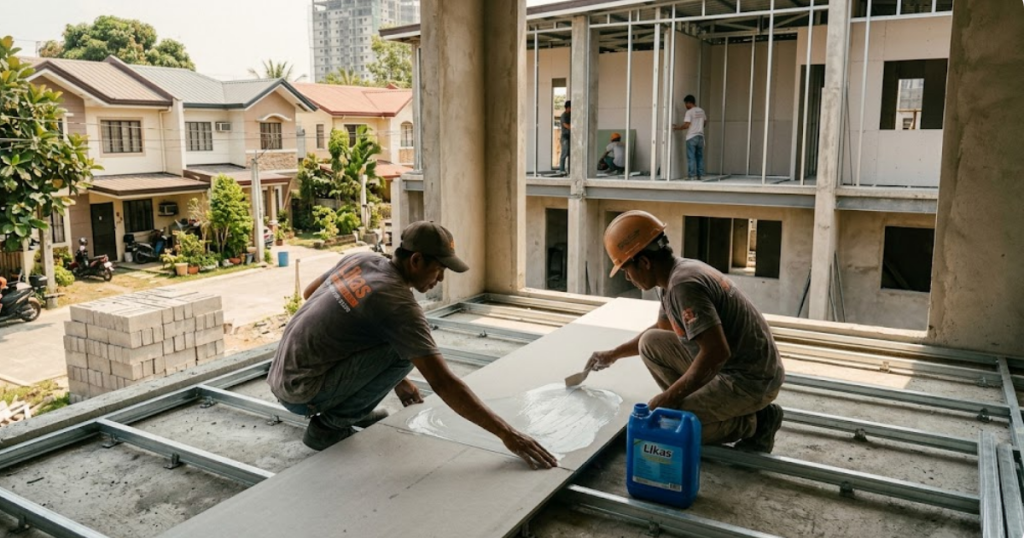
In 2026, Philippine construction favors drywall and dry-floor systems, including fiber cement board installation, for faster builds. While efficient, these are more flexible than traditional concrete building materials. Standard mortar works on rigid surfaces like exposed aggregate concrete or fair-faced concrete, but its brittle nature makes it unsuitable for flexible substrates affected by movement, humidity, or structural sway.
Latex additives solve this by enhancing elasticity and vibration resistance, making them essential under current safety benchmarks and mandatory product certifications (Department of Public Works and Highways. (2015) — especially in high-rise applications.
Three Applications for Latex-Modified Adhesives
1. Tiling on Marine Plywood and Fiber Cement
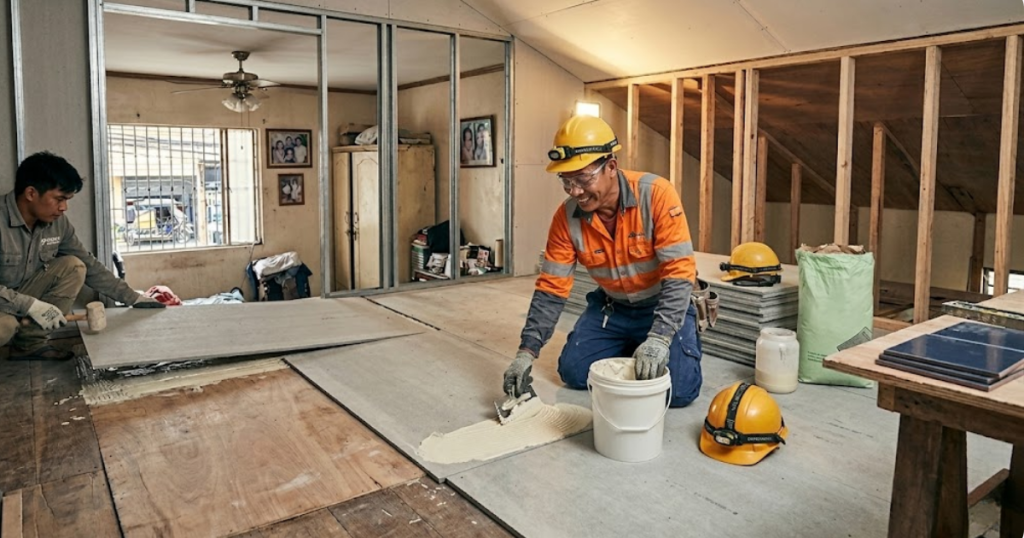
In many Filipino home extensions and loft conversions, marine plywood and fiber cement boards are widely used. Proper fiber cement board installation combined with latex-modified adhesives creates a reliable bond between organic and inorganic materials. Philippine Institute of Civil Engineers (PICE). (2024)
- Benefits: Prevents tile cracking caused by humidity-driven expansion.
- Solution: Use a high-performance tile adhesive for plywood enhanced with latex additives.
- Setting Time: 24 hours (light traffic), 7 days (full cure).
2. Large-Format Slabs Over Waterproof Membranes
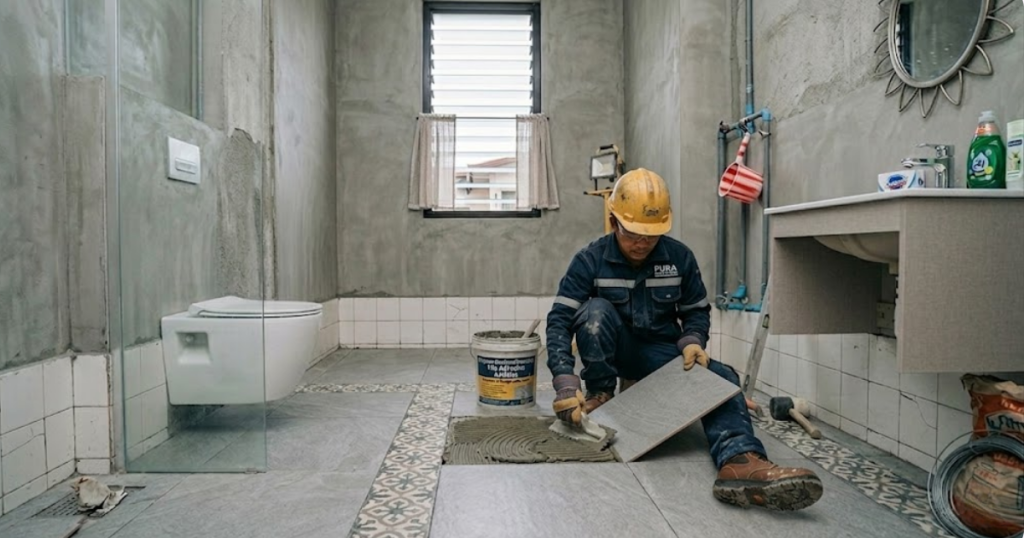
Modern bathrooms often include waterproofing systems beneath tiles. These surfaces are difficult for standard mortars to grip, especially when paired with sleek finishes like polished concrete interiors or exposed concrete finish walls.
- Benefits: Superior bonding due to high polymer content.
- Solution: Use a premium tile adhesive additive to improve adhesion and flexibility.
- Result: Supports large-format tiles without sagging or detachment.
3. Tile-on-Tile (The “No-Hacking” Renovation)
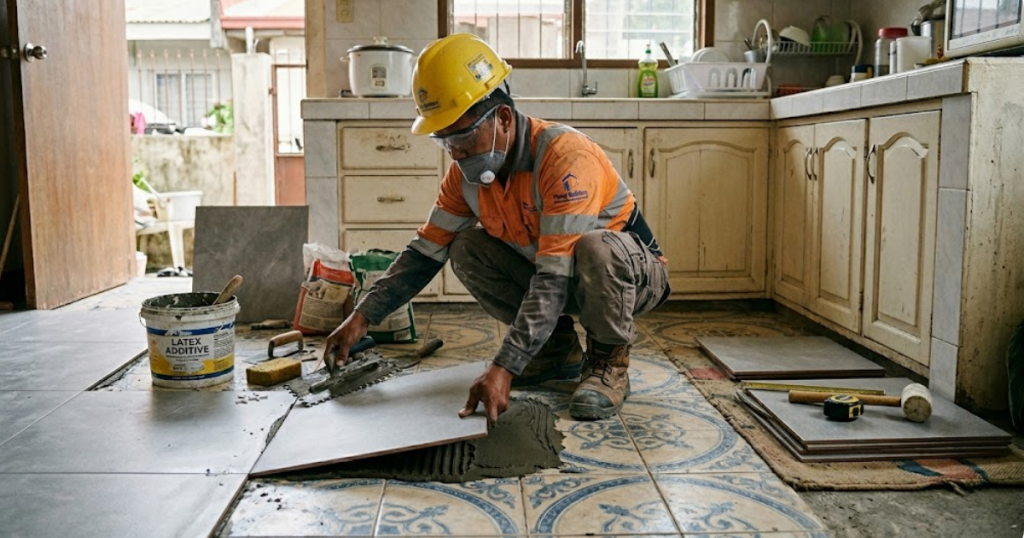
To minimize labor and debris, many homeowners now install new tiles over existing ones. This method, while efficient, is prone to common tile installation problems if improper materials are used.
- Benefits: Eliminates demolition work.
- Solution: Latex additives provide strong adhesion to glazed surfaces.
- Result: Durable bonding without compromising structural integrity.
The Practical Edge: Flexibility and Setting Times
| Feature | Standard Thin-set | Latex-Modified Mortar |
| Flexibility | Low (Brittle) | High (Vibration resistance) |
| Water Absorption | Moderate | Low (Hydrophobic) |
| Shear Bond Strength | $\approx 150$ psi | $\approx 400+$ psi |
| Substrate Fit | Concrete only | Plywood, Tile, Metal, Boards |
Latex-modified systems are especially effective when working across mixed surfaces—from traditional slabs to modern finishes like exposed aggregate concrete or fair-faced concrete. They also significantly reduce water permeability, making them ideal for flood-prone environments according to industry technical discussions This adherence to rigorous structural standards ensures compliance with modern national building guidelines (Department of Trade Industry. [DTI], 2026).
Solving the “Popping Tile” (Bongol) Crisis
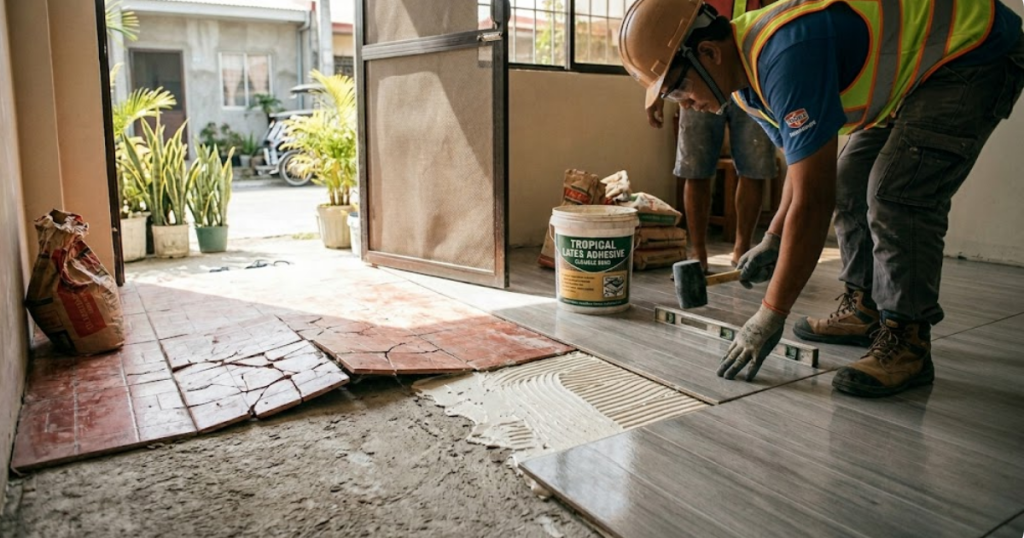
In the Philippines, a very challenging issue that a lot of tile installers face is tile delamination. In extreme temperatures, tiles can exceed 50°C. Rapid thermal expansion and contraction occurs very quickly. Problems are more severe when tiles are placed over rigid substrates, such as structural slabs, or over decorative finishes like exposed concrete.
Simple standard mortars cannot absorb this stress; therefore, tiles will buckle and debond. Unlike standard latex-modified adhesives, mortars will function as an elastic, mobile buffer layer and provide some degree of controlled displacement. This additional elasticity will prevent severe damage. Integrating latex-modified mortars will provide long term performance and durability even under extreme tropical conditions.
Conclusion
As the Philippine construction industry undergoes and embraces continuous innovation, evolving from the traditional use of slab technology, the requirements for the different types of construction bonding materials become more sophisticated. This applies to the range of materials from concrete to modern board systems, as well as those used for architectural finishes, including polished concrete as interiors. Flexible and high-performing adhesive systems are needed.
The use of latex additives is no longer a pleasant option. They are a requirement. They improve the adhesive performance of tiles when used on plywood, and with tile adhesive additives, are able to provide the required endurance to withstand the test of contemporary construction.
References
Construction Industry Authority of the Philippines. (2022). CIAP document 102: Uniform general conditions of contract for private construction (2022 ed.)
Department of Trade Industry. (2026). REPORT ON THE INITIATION OF A PRELIMINARY INVESTIGATION ON THE APPLICATION FOR SAFEGUARD MEASURES ON THE IMPORTATION OF CERAMIC TILES FROM VARIOUS COUNTRIES




 Facebook
 Instagram
 Linkedin
 Twitter
 Youtube
