

Sources relied on: McKinsey Technology Trends Outlook 2025, World Economic Forum reporting on construction digital transformation (2025), and the Asian Development Bank / Philippines country program documents (2024–2025).
1) Generative AI & predictive analytics for design, planning, and schedule optimization
- How it helps: automates repetitive design decisions, runs many trade-off scenarios (time, cost, carbon), and predicts delays or cost overruns using historical project data.
- Safety: simulates hazards and tests mitigation scenarios before build.
- Efficiency: shortens design cycles and improves schedule reliability. Cost: reduces rework and contingency by improving early estimates and risk detection.
- Evidence: McKinsey (2025) highlights AI as a top cross-sector trend with concrete AEC use cases in 2025.
- Already applied by global contractors and developers to optimize schedules, cost forecasts, and risk registers using live project data. McKinsey documents multiple AEC firms using AI-driven planning tools to reduce schedule overruns and detect cost risks mid-project, not post-mortem.
2) Advanced BIM + digital twins (real-time, interoperable models)
- How it helps: a single, continuously updated digital model connects design, site sensors, procurement, and facilities management.
- Safety: live clash detection and simulated egress/evacuation tests.
- Efficiency: faster coordination, fewer RFIs, optimized logistics. Cost: extends lifecycle visibility—reduces operating costs and retrofit surprises.
- WEF (2025) emphasizes data governance and collaboration as prerequisites for digital transformation in construction.
- Mandated or contractually required in major infrastructure projects across the EU, UK, Singapore, and parts of East Asia. Digital twins are actively used in airports, rail systems, and high-rise buildings for construction coordination and facilities management, not just design visualization.
3) Robotics and autonomous equipment (excavators, bricklaying robots, cobots)
- How it helps: takes humans out of repetitive, hazardous tasks while increasing throughput.
- Safety: reduces onsite injuries from manual heavy lifting and repetitive strain.
- Efficiency: robots run longer and more predictably than manual crews for specific tasks.
- Cost: higher upfront CAPEX but lower labor and rework costs; faster schedules lower finance/overhead. McKinsey and industry surveys show accelerating deployment of automation on sites.
- Autonomous earthmoving equipment from companies like Caterpillar and Komatsu is already operating on large infrastructure and mining-adjacent construction sites. Bricklaying and rebar-tying robots are deployed on commercial projects where repetition and scale justify automation.
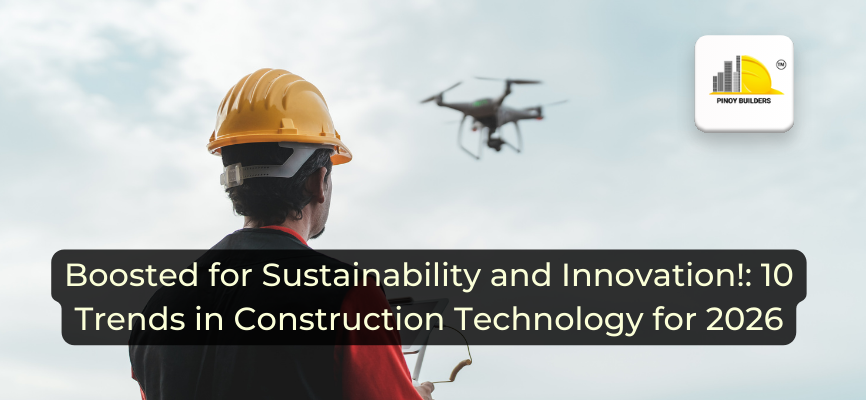
4) Drones and autonomous surveying (mapping, inspection)
- How it helps: fast, frequent site surveys, progress tracking, and remote safety inspections.
- Safety: reduces need for workers to access dangerous heights/edges.
- Efficiency: daily progress monitoring and automated volume calculations speed decisions.
- Cost: cuts survey labor and reduces errors that lead to costly fixes. WEF coverage notes drones as a core digital tool in modern project workflows.
- Standard practice in large-scale construction worldwide. Used daily for progress validation, volumetric measurement, and safety audits. This is one of the most mature construction technologies, fully normalized across the industry.
5) IoT sensors, wearables, and environmental monitoring
- How it helps: wearable tags, proximity sensors, and environmental monitors feed real-time safety alerts and equipment telemetry into project dashboards.
- Safety: immediate alerts for falls, heat stress, toxic gases, or proximity to moving machinery.
- Efficiency: predictive maintenance for equipment; better resource allocation.
- Cost: fewer incidents (lower insurance and downtime) and optimized equipment utilization. McKinsey identifies pervasive sensing and edge analytics as high-impact trends.
- Live deployment on major sites for worker tracking, heat stress alerts, equipment monitoring, and structural health monitoring. These systems are tied into site dashboards and insurance risk assessments, not experimental labs.
6) Modular/off-site prefabrication and industrialized construction
- How it helps: moves labor-intensive work into controlled factory settings.
- Safety: fewer onsite hazards and better quality control.
- Efficiency: parallel site and factory work shortens total program duration.
- Cost: predictable unit costs, less weather-related delay, and reduced waste. Global analyses show modularization scaling rapidly in buildings and infrastructure segments.
- Actively used in hospitals, hotels, residential towers, and social housing. Entire building sections are manufactured, transported, and assembled on-site. Asia-Pacific has some of the highest adoption rates due to labor and land constraints.
7) Additive construction / large-scale 3D printing
- How it helps: prints structural elements or entire small buildings with optimized material use and complex geometries.
- Safety: reduces manual formwork and repetitive tasks
- Efficiency: rapid production of bespoke components and reduced material transport.
- Cost: material-efficient designs and lower formwork/labor costs for specific use cases (e.g., retaining walls, low-rise housing). McKinsey flags additive methods as part of the manufacturing shift in construction.
- Already used to build low-rise housing, bridges, walls, and structural components in Asia, Europe, and the Middle East. While not universal, it is fully operational in niche applications where speed, geometry, or labor reduction matters.
8) Advanced materials and low-carbon binders (self-healing concrete, geopolymer cements, composites)
- How it helps: longer-lasting structures, smaller repair cycles, and lower embodied carbon.
- Safety: improved durability reduces failure risk; materials that resist corrosion/fire improve life safety.
- Efficiency: lighter materials simplify logistics and foundations.
- Cost: higher unit price may be offset by longer service life and lower maintenance. Global sustainability (2025) reports underline material innovation as essential to decarbonizing the sector.
- Self-healing concrete, fiber-reinforced polymers, geopolymer cement, and fire-resistant composites are specified in real infrastructure and high-performance buildings. Adoption is driven by durability requirements and lifecycle cost reduction, not experimental curiosity.
9) Augmented Reality (AR) / Mixed Reality for onsite guidance and training
- How it helps: overlays plans onto the built environment for installation, QA, and safety briefings.
- Safety: real-time hazard markers and stepwise instructions reduce errors.
- Efficiency: speeds first-time-right installations and field troubleshooting.
- Cost: reduces rework, shortens onboarding, and allows remote expert oversight. WEF highlights AR/VR as key tools for upskilling and remote assistance in construction digitalization.
- Used by contractors for installation guidance, quality checks, and remote expert supervision. Workers already wear AR headsets on complex builds to reduce errors and training time.
10) Integrated energy & sustainability systems (on-site storage, smart microgrids, embodied-carbon tracking)
- How it helps: integrates renewable generation, storage, and active monitoring into project planning and operation.
- Safety: resilient power systems support critical site equipment and safety systems during outages.
- Efficiency: lowers operating energy through smart control.
- Cost: reduces lifecycle operating expenses; carbon-tracking tools help meet regulatory and client requirements, avoiding future retrofit penalties. Global reports position sustainability tech as non-negotiable for future projects.
- Smart energy systems, embodied-carbon tracking, and on-site storage are already embedded in commercial developments and public infrastructure projects, particularly where ESG compliance or resilience standards apply.
Net effects across the ten technologies (summary)
- Safety: automation, wearables, and remote inspection remove workers from the most hazardous tasks and provide faster emergency response and hazard prediction.
- Efficiency: digital twins, AI, prefabrication, and robotics compress schedules by enabling parallel workstreams and reducing rework.
- Cost management: upfront investment rises (software, sensors, factory capacity), but predictable factory costs, fewer delays, less rework, lower O&M, and insurance savings typically yield favorable total cost of ownership for repeatable projects.
Philippines’ readiness to adopt these technologies — analysis (policy, skills, finance, and market)
Drones, BIM, modular construction, and advanced materials are already in use on major Philippine infrastructure and private developments. AI-driven planning, digital twins, robotics, and AR are present via foreign contractors, joint ventures, and flagship projects, not yet mainstream among local SMEs.
- Policy & financing environment: ADB and Philippine planning documents show active multilateral support for digitalization, infrastructure scaling, and PPP models, but they also note regulatory and implementation gaps that slow private investment. Public funding plus donor programs can de-risk pilots, yet procurement rules and bureaucracy often slow tech procurement.
- Digital infrastructure & data governance: progress exists (national digital plans, PPP initiatives for digital infrastructure) but uneven broadband, fragmented data standards, and limited interoperability in government project systems will constrain full digital-twin/BIM rollout at scale without focused investment and standards.
- Workforce & skills: the WEF and McKinsey analyses wants to focus on upskilling as a gating factor. The Philippines has a large construction workforce but will need rapid reskilling programs (AI literacy, BIM/Digital Twin, robotics maintenance) and stronger industry-academe partnerships to capture benefits.
- Market structure & contractors: many Filipino contractors are small/medium firms that may lack capital or scale for factory modularization or robotics. Early wins will likely come from large infrastructure programs and foreign-partnered developers meanwhile incentives, tax support, and modular manufacturing hubs would accelerate SME participation.
- Climate resilience and sustainability drivers: frequent climate shocks make resilient, low-carbon construction attractive; however, procurement and enforcement must align to reward lifecycle performance and durable materials adoption. ADB cooperation on resilient infra is an enabling signal.
Practical implications for Filipino stakeholders (priorities)
- Government: set BIM/interoperability standards, pilot procurement pathways for modular/tech-enabled projects, and target PPPs for digital infrastructure.
- Contractors: partner with tech providers for phased pilots (sensors + digital twin + AI scheduling) to create proof points that scale.
- Academia/TVET: accelerate curricula for BIM, AI in construction, and robotics maintenance; short modular upskilling for existing workforce.







 Facebook
 Instagram
 Linkedin
 Twitter
 Youtube