
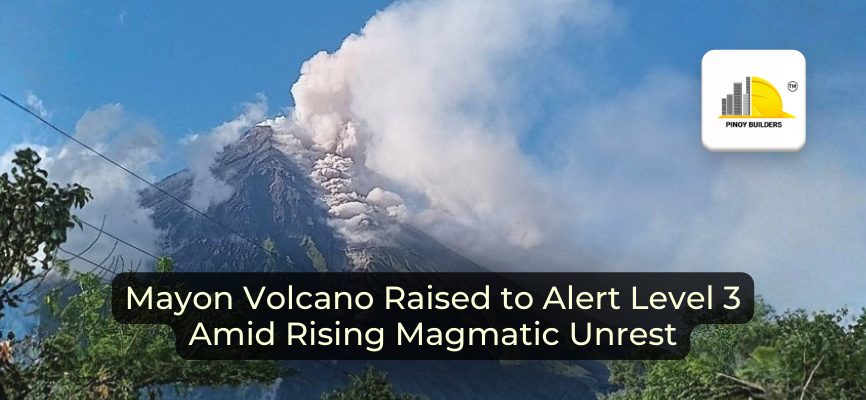
LEGAZPI CITY, Albay — The Philippine Institute of Volcanology and Seismology (Phivolcs) raised the status of Mayon Volcano to Alert Level 3 on Tuesday, January 6, following a rapid increase in rockfall events and the observation of pyroclastic density currents (PDCs).
The agency warned that the volcano is now exhibiting a “high level of unrest,” indicating that magma is near or at the surface, and the possibility of a hazardous eruption within weeks or even days has increased.
Escalating Activity
According to Phivolcs, the decision to elevate the alert level from 2 to 3 was driven by the “repeated collapse of the unstable summit dome,” which has generated a growing volume of rockfall events.
Since January 1, 2026—when the volcano was initially placed under Alert Level 2—state seismologists have recorded a total of 346 rockfall events and four volcanic earthquakes. This marks a significant spike compared to the 599 events recorded over the entire two-month period of November and December 2025.
A critical development occurred at 12:26 p.m. on Tuesday, when Phivolcs observed PDCs cascading down the Bonga Gully (southeast slope). The event, triggered by the collapse of newly extruded lava, lasted for approximately three minutes and reached a distance of two kilometers from the crater.
“The volume of discrete rockfall, with observed incandescence at nighttime, increased yesterday, signaling an increase in the rate of dome growth and the onset of extrusion of new lava at the crater,” Phivolcs stated in its advisory.
Hazards and Warnings
Under Alert Level 3, Mayon is technically in a state of magmatic eruption. While sulfur dioxide emissions remain at baseline levels, ground deformation data indicates persistent inflation on the volcano’s eastern and southeastern slopes.
Phivolcs Director Teresito Bacolcol advised residents within the 6-kilometer Permanent Danger Zone (PDZ) to be prepared for immediate evacuation due to the danger of PDCs, lava flows, and rockfalls.
Authorities have also warned of potential ashfall on the southern slopes based on current wind patterns. Aviation officials have been instructed to advise pilots to avoid flying close to the volcano’s summit, as sudden explosions could eject hazardous ash and debris into the air.
Local disaster response teams in Albay remain on high alert as the situation develops.








 Facebook
  Instagram
  Linkedin
  Twitter
  Youtube