
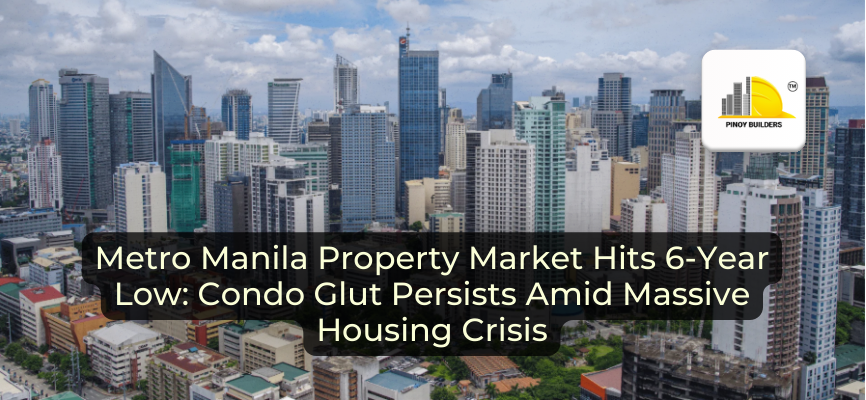
MANILA, Philippines — The Philippine real estate market is closing 2025 with a stark contradiction: while developers struggle to sell thousands of empty condominium units in the capital, millions of low-income families remain without homes.
According to a new report by Leechiu Property Consultants (LPC), demand for residential units in Metro Manila has plummeted to a six-year low, leaving the capital with a massive inventory of 80,300 unsold homes. Experts estimate it could take up to 42 months—or three and a half years—to clear this oversupply.
The “POGO” Effect and Secondary Market Competition
The glut is largely attributed to the exit of Philippine Offshore Gaming Operators (POGOs), which triggered a wave of vacancies. Roy Golez, director for research at LPC, noted that units previously occupied by foreign workers are now flooding the secondary market at discounted rates, directly competing with developers’ new projects.
“Fewer speculative buyers have dampened primary take-up while motivated sellers from the POGO period compete in the secondary market with aggressive pricing,” Golez stated.
Data shows that only 24,732 residential units were sold in Metro Manila this year—a 3% drop from 2024 and the lowest annual total since the pandemic onset in 2020. In response, developers have slammed the brakes on new projects, with only 5,256 new units launched this year, a 60% plunge from the previous year.
A Tale of Two Markets
The slowdown is unevenly felt. The “affordable” middle-income segment (P2.3 million to P4 million) has been hit hardest, with demand halving to just 1,883 units sold.
In sharp contrast, the luxury market is thriving. Sales of luxury units priced above P68 million surged by 36%, while upscale units (P7 million–P12 million) saw a 14% increase. This divergence highlights a widening affordability gap where the wealthy continue to invest while middle-class buyers are squeezed out by high costs and strict loan requirements.
The 10-Million Home Deficit
While high-rises sit empty, the country faces a critical shortage of socialized housing. Recent government data reveals a staggering backlog of 10.65 million housing units for the low-income sector.
To address this, the Marcos administration continues to push the Pambansang Pabahay Para sa Pilipino (4PH) program, which aims to build affordable high-rise communities near transport hubs. However, the private sector remains cautious. While the government has extended the deadline for developers to comply with the “Balanced Housing” law—which mandates that developers allocate a portion of their projects to socialized housing, compliance remains a hurdle due to thin profit margins in the low-cost sector.
Inventory Hotspots
For buyers looking for deals, the oversupply is most concentrated in:
- Quezon City: 19,400 unsold units
- Ortigas/Mandaluyong/Pasig: 14,200 unsold units
- Bay Area (Pasay/Parañaque): 13,100 unsold units
Conversely, Makati City remains the tightest market with only 2,140 unsold units.
As 2026 approaches, the market remains in what analysts call a “recalibration phase,” with developers offering aggressive promos to move stock while the government races to incentivize the construction of homes for the poor.





 Facebook
  Instagram
  Linkedin
  Twitter
  Youtube