Choosing the Right Construction Setup for Your Project
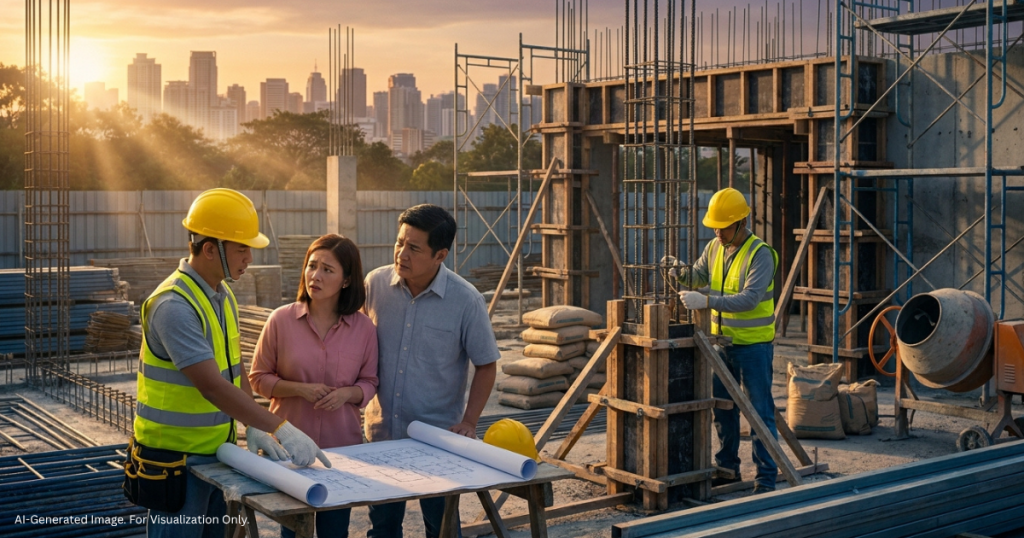
Building a home in the Philippines is a major milestone. Whether it is a small house, an extension, or a commercial space, you face one critical question: “What type of construction setup is best for my project?”
In the local building industry, you will usually choose between working with a regular licensed contractor or using the traditional “pakyaw” system (Construction Industry Authority of the Philippines [CIAP], n.d.). With building material prices hitting a two-year high in early 2026 (BusinessWorld Online, 2026), this choice can make or break your finances.
Both setups have their place depending on your budget, timeline, and how hands-on you want to be. Understanding their core differences is the key to protecting your hard-earned savings.
Key Takeaways
- The Setup Choice: Choose between the hands-off structure of a licensed contractor or the flexible control of the traditional pakyaw system.
- The Legal Pakyaw Alternative: Under RA 4566 and RA 11711, small local builders can get a licensed “Pakyaw” status with a low equity requirement of Php 20,000.
- Heavy Unlicensed Penalties: Building or bidding without a valid PCAB license carries heavy legal fines ranging from Php 100,000 to Php 500,000, plus 1 percent of the project cost.
- Budget Realities: Materials swallow up 55% to 60% of your total budget. Professional cost planning is your best defense against waste.
- Durability First: Investing in proper engineering compliance guarantees your home’s safety and value over a 10-to-20-year horizon.
1. Understanding the Two Approaches: Regular Contractor vs. Pakyaw System
Before breaking ground, you must understand how these two systems function operationally on the job site.
The Licensed Contractor Setup
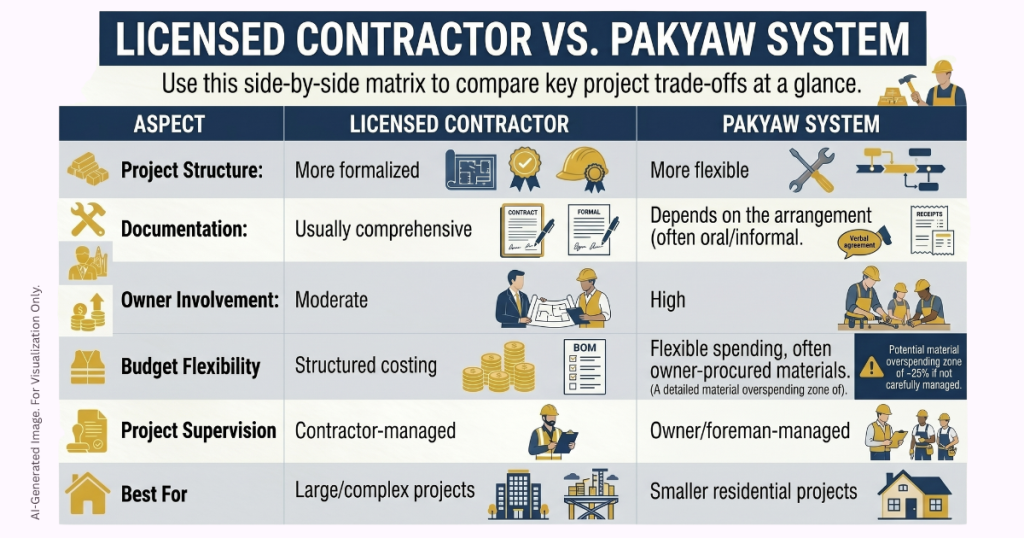
A licensed contractor typically operates with a highly structured construction process (Philippine Contractors Accreditation Board [PCAB], n.d.). This setup is commonly preferred for larger-scale projects, commercial developments, and builds requiring strict compliance and documentation:
- Professional Management: Full handling of daily labor, material logistics, and timelines.
- Technical Coordination: Works directly with licensed architects and engineers to align your blueprints.
- Permits and Legalities: Manages municipal clearances, tax papers, and occupancy permits.
- Binding Contracts: Clear progress billing and legally enforceable timelines.
- Active Supervision: Continuous quality control by certified site engineers.
The Pakyaw System
The pakyaw system is an informal, highly flexible labor arrangement where you deal directly with local trade teams or foremen. It is highly popular for provincial builds and small renovations because it offers:
- Budget Control: The freedom to buy your own materials and fund the build phase-by-phase.
- Direct Input: You act as your own project manager and have the final say on-site.
- Fast Decisions: No corporate delays; you make changes directly with the foreman.
- Hands-on Labor Management: Direct, flexible relationships with masons and carpenters.
2. Comparing Construction Priorities and Budgets
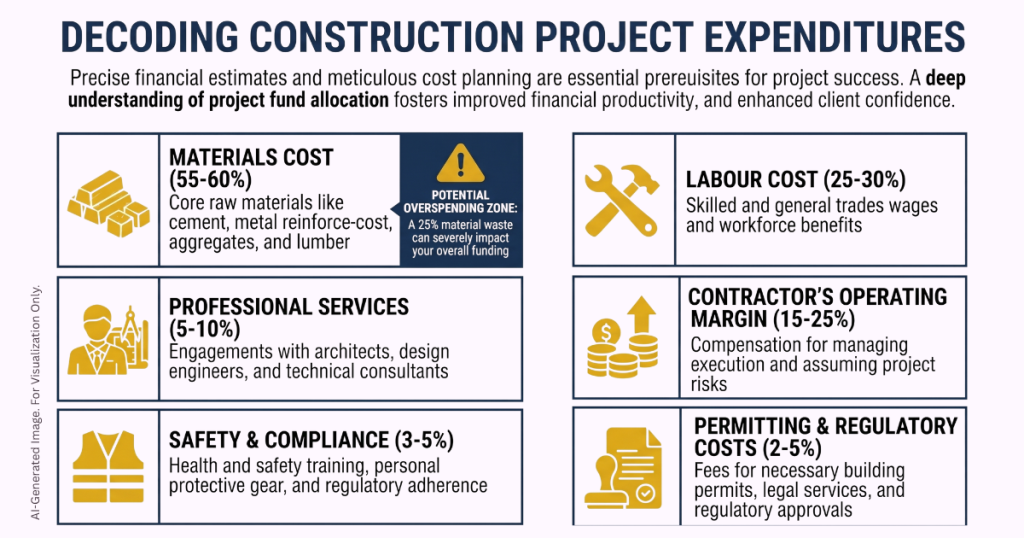
Where does your money actually go during a build? Standard industry estimates show a clear breakdown of construction project costs (Construction Industry Authority of the Philippines [CIAP], n.d.):
Preventing Material Waste and Project Failures
Because materials swallow 55% to 60% of your budget, procurement efficiency is critical.
Unlicensed, informal builds often order supplies on the fly without a detailed Bill of Materials (BOM). This is one of the most common mistakes in construction, resulting in heavy Construction material waste as raw materials spoil under the rain or are cut incorrectly (Philippine Statistics Authority [PSA], 2024). If you run a pakyaw project, you must actively track your inventory to ensure your budget doesn’t dissolve into wasted steel and concrete.
3. “More Affordable… But Is It Safe?” The Structural Engineering Risk
No matter how you fund your project, your home must be built to survive earthquakes and typhoons. Under the National Building Code of the Philippines, PD 1096, structural plans must be signed and sealed by licensed civil engineers (Office of the President of the Philippines, 1977).
Bypassing professional Structural engineering to avoid upfront professional fees (which only make up 5% to 10% of the budget) exposes your home to structural errors that directly compromise its Structural integrity (Department of Public Works and Highways [DPWH], 2026):
- Improper Concrete Mixes: Unsupervised crews often hand-mix concrete on bare dirt, creating a weak, sandy mix that cracks under pressure.
- Incorrect Steel Spacing: Placing rebars too far apart or using thin, sub-standard steel sizes drastically lowers the load capacity of columns and beams.
- Shallow Foundations: Guessing footing depths based on “experience” rather than local soil capacity causes homes to settle unevenly and crack over time.
Plaster and paint can easily hide these mistakes during turnover, but nature will always expose them later.
4. Understanding RA 4566 and the Legal Pakyaw Requirements
The traditional “Pakyaw” system has a legal, regulated pathway under Philippine law. To protect homeowners, Republic Act No. 4566 (Philippine Congress, 1965), amended by Republic Act No. 11711 (Philippine Congress, 2022), offers a specialized “Pakyaw” Contractors License with simplified parameters:
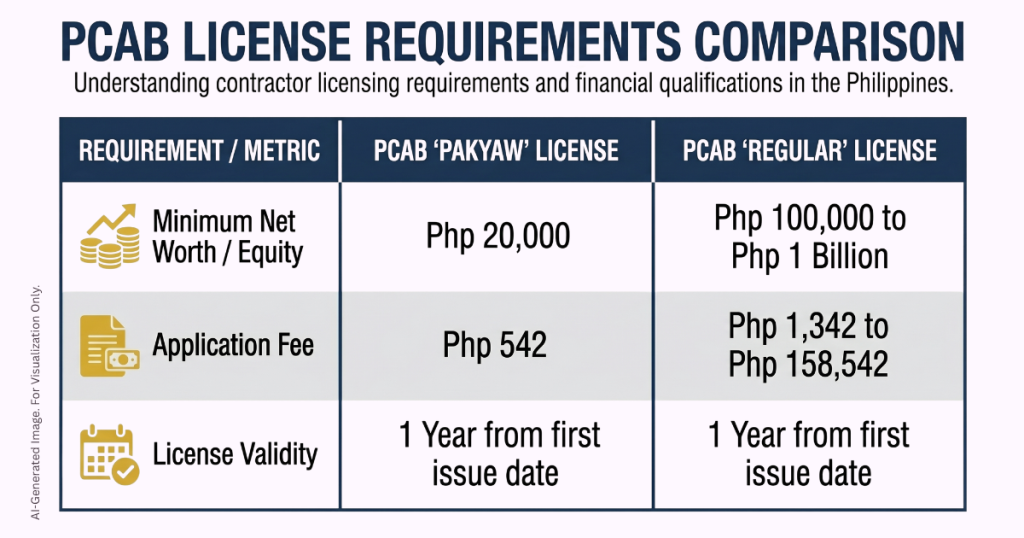
Legal Application Prerequisites for a Pakyaw License (Philippine Contractors Accreditation Board [PCAB]):
- DTI Business Name Registration: Must have a territorial scope of at least the city or municipal level.
- Audited Financial Statement: Demonstrating a net worth of at least Php 20,000.
- Authorized Managing Officer (AMO) Qualifications:
- Must be at least 18 years old.
- Must hold at least one National Certification (NC) 2 issued by TESDA in a construction-related skill.
- Must submit a Certificate of Completion of a One-day Entrepreneurial Course.
- Must submit a Certificate of Completion of a One-day Safety Seminar.
Severe Penalties for Non-Compliance
Hiring completely unlicensed workers is a direct violation of Republic Act No. 4566 (Philippine Congress, 1965). To safeguard public safety, the law outlines strict penalties for non-compliance (Philippine Congress, 2022):
- Submitting Bids Without a License: Fines ranging from Php 100,000 to Php 500,000, plus an additional 1% of the total project cost for undertaking construction work without a valid PCAB license.
- Engaging in Project Contracting Without Qualifications: Fines ranging from Php 500 to Php 5,000.
- Misrepresentation and Fraudulent Acts: Fines ranging from Php 500,000 to Php 1,000,000, alongside potential imprisonment ranging from 1 to 6 years for impersonation or the use of expired/invalid licenses.
Furthermore, construction sites are inherently hazardous. If an unlicensed worker suffers an injury on your property, you, as the de facto employer, can be held directly liable for their medical bills (Department of Labor and Employment – National Wages and Productivity Commission [DOLE-NWPC], 2024). Licensed contractors, including Pakyaw licensees who have completed safety seminars, carry comprehensive general liability insurance and provide appropriate safety gear (PPE) to shield the property owner from financial ruin (Occupational Safety and Health Center [OSHC], n.d.).
5. The Four Stages of Planning to Build a House
To execute a successful build under either setup, homeowners should follow the standard four-stage planning framework:
- Stage 1: Research & Design: Conduct market research, define your household needs, and conceptualize the architectural design.
- Stage 2: Construction Planning: Create a realistic timeline, obtain the necessary LGU permits, and establish a material scheduling plan.
- Stage 3: Building Process: Lay the foundations, frame the structure, and execute the plumbing and electrical work under professional guidance.
- Stage 4: Finishing Touches: Focus on interior design, landscaping, final inspections, and securing your Certificate of Occupancy before move-in.
6. Quick Comparison: Licensed Contractor vs. Pakyaw System
Conclusion: Value is Measured in Decades, Not Days
There is no single “perfect” building method. The right choice depends entirely on your budget, project scale, and how much time you can spend on-site. However, saving money upfront by hiring an unlicensed crew is an expensive gamble that often leads to high Construction material waste, project delays, and long-term structural failure.
Protect your investment by hiring licensed professionals. If your budget is tight, look for a builder holding a valid PCAB Pakyaw License. Ensure the structural skeleton of your home is calculated by a civil engineer and executed correctly to secure its Structural integrity. You can always save up for premium finishes later, but you can never easily repair a weak foundation.
Disclaimer
This article is intended for informational purposes only. Construction requirements, permits, project responsibilities, and contractor obligations may vary depending on project scope, local government regulations, and specific construction arrangements. Property owners are encouraged to consult licensed professionals and verify contractor credentials through the Philippine Contractors Accreditation Board (PCAB).
References
BusinessWorld Online. (2026, April 15). Metro Manila wholesale building materials price growth hits two-year high in March. https://www.bworldonline.com/economy/2026/04/15/743198/metro-manila-wholesale-building-materials-price-growth-hits-two-year-high-in-march/
Construction Industry Authority of the Philippines. (n.d.). Official construction industry licensing framework and rules. Department of Trade and Industry. https://pcabgovph.com/assets/Rules%20and%20Regulation%20Governing%20Licensing%20of%20Constructors.pdf
Department of Labor and Employment – National Wages and Productivity Commission (DOLE-NWPC). (2024). Summary of current regional daily minimum wage rates. https://nwpc.dole.gov.ph/summary-of-current-regional-daily-minimum-wage-rates-non-agriculture-agriculture-and-other-wage-categories/
Department of Public Works and Highways (DPWH). (2026). Official DPWH standard guidelines, building issuances and material specifications. https://www.dpwh.gov.ph/dpwh/references/guidelines_manuals
Occupational Safety and Health Center. (n.d.). Construction safety protocols and work environments guidelines. Department of Labor and Employment. https://oshc.dole.gov.ph
Office of the President of the Philippines. (1977, February 19). Presidential Decree No. 1096, s. 1977: Adopting a National Building Code of the Philippines thereby revising Republic Act Numbered Sixty-Five Hundred Forty-One. Official Gazette of the Republic of the Philippines. https://www.officialgazette.gov.ph/1977/02/19/presidential-decree-no-1096-s-1977/
Philippine Congress. (1965, June 19). Republic Act No. 4566: An act creating the Philippine Licensing Board for Contractors, prescribing its powers, duties and functions, providing funds therefor, and for other purposes (Contractors’ License Law). Official Gazette of the Republic of the Philippines. https://www.officialgazette.gov.ph/1965/06/19/republic-act-no-4566/
Philippine Congress. (2022, April 27). Republic Act No. 11711: An act further amending Republic Act No. 4566, as amended, otherwise known as the “Contractors’ License Law”. Official Gazette of the Republic of the Philippines. https://www.officialgazette.gov.ph/2022/04/27/republic-act-no-11711/
Philippine Contractors Accreditation Board. (n.d.). Official contractor registration and licensing portal. Department of Trade and Industry. https://pcab.construction.gov.ph/verify/
Philippine Statistics Authority (PSA). (2024). Construction statistics from approved building permits. https://psa.gov.ph/statistics/construction/pcs






 Facebook
 Instagram
 Linkedin
 Twitter
 Youtube
