
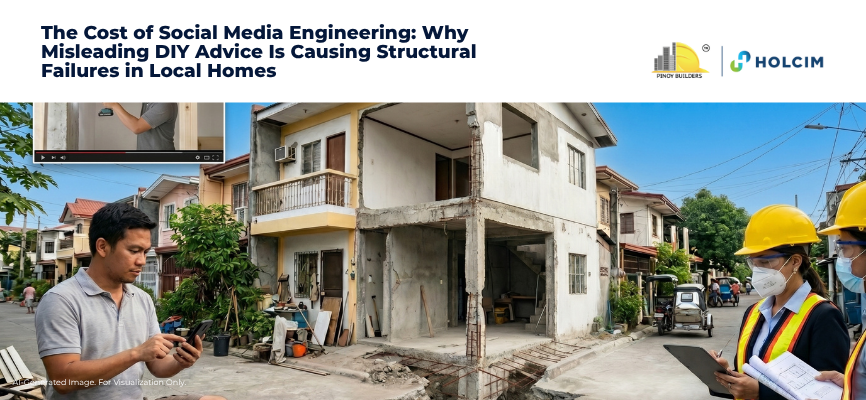
The Dangerous Rise of Viral Construction Hacks
In the age of 30-second viral videos, social media feeds are flooded with satisfying DIY transformations. From quick room extensions to budget-friendly wall removals, content creators make complex structural work look as simple as a weekend craft project. Across social media platforms, these unverified construction hacks promise to save homeowners hundreds of thousands of pesos by cutting out professional fees.
But on a physical job site, there is no undo button.
In the Philippines, local structural engineers are raising alarms over the real-world consequences of social media engineering. What is packaged as an innovative cost-cutting tip online often translates to dangerous building practices in reality. For the average Filipino family, following unverified digital advice doesn’t just jeopardize their hard-earned savings; it puts their lives at risk.
Key Takeaways
- The Viral Trap: Short-form DIY videos frequently promote structurally unstable shortcuts that bypass basic physics and safety codes.
- The Critical Hazards: Unscientific concrete mixing, guesswork rebar spacing, and blind load-bearing modifications are leading to severe home damage.
- Legal and Civil Liabilities: Bypassing professional civil engineers constitutes a severe building code violation and voids future structural insurance or legal protections.
- The Ultimate Safety Baseline: Just because a construction tutorial gains millions of views online does not mean it is safe, durable, or structurally sound for your family.
1. The Big Three: Real-World Hazards Born from Online Misinformation
When amateur builders attempt to replicate viral videos, they often commit fundamental construction mistakes that compromise the bones of their homes. Local structural audits repeatedly reveal three major hazards directly linked to misleading social media advice:
Guesswork-Based Concrete Mixing Ratios
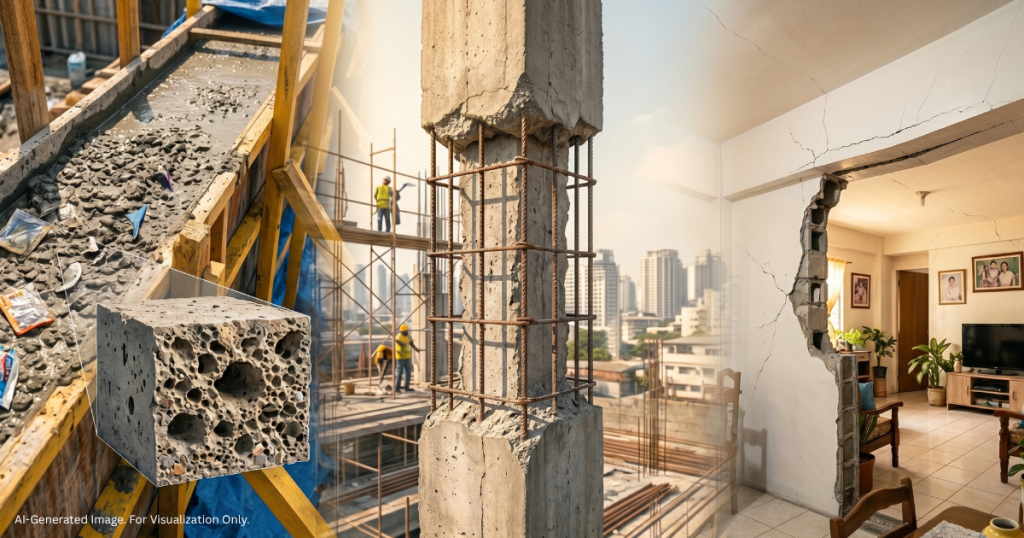
A highly popular online hack shows DIYers mixing concrete using arbitrary containers or by feel, claiming that adding extra water makes the pour easier. In structural engineering, water-to-cement ratios must be calculated down to the decimal point to ensure absolute safety parameters (Department of Public Works and Highways [DPWH], 2026). Excess water creates microscopic pathways inside the curing concrete as it evaporates, leaving a highly porous, brittle structure. This is exactly how poorly mixed concrete fails under load, leading to crumbling columns and weak foundations that cannot support the weight of the house.
Inadequate Rebar Column Spacing
Some viral tutorials suggest reducing the amount of steel reinforcement or spreading out the horizontal ties (stirrups) in concrete columns to save money on steel. This is a recipe for a catastrophic structural failure. Steel provides the necessary tensile strength that prevents concrete from breaking apart when the ground shakes or when heavy winds hit. According to the Association of Structural Engineers of the Philippines (ASEP, 2025), spacing structural rebars too far apart destroys the column’s ability to hold up the home during critical seismic events.
Blind Load-Bearing Assumptions
Perhaps the most dangerous trend online is the open-concept renovation trend, where DIYers confidently knock down interior walls. Many creators mistakenly claim that “if a wall is made of hollow blocks, it isn’t load-bearing.” In many classic two-story Filipino homes, concrete hollow block (CHB) walls are integrated into the structural frame to distribute vertical loads. Cutting into these walls without an engineer’s assessment redirects thousands of kilograms of weight onto weak spots, resulting in sagging beams, buckling ceilings, and deep foundation cracks.
2. Severe Building Code Violations and Legal Liabilities
Beyond the physical danger of poor construction, homeowners who follow unverified DIY advice face significant legal and financial consequences.
Under Presidential Decree No. 1096, also known as the National Building Code of the Philippines, any structural modification, addition, or alteration requires a formal building permit issued by the local Office of the Building Official (OBO) (Office of the President of the Philippines, 1977). Securing this permit requires structural plans that are signed and sealed by a licensed Civil or Structural Engineer.
Bypassing this process to execute a DIY hack constitutes a serious building code violation. For example, a quick ₱15,000 DIY unreinforced cement pour done in May to avoid engineering fees can easily turn into a ₱150,000+ repair bill by July. Homeowners end up paying ten times more to cover the costs of emergency structural audits, the demolition of the weak concrete, re-pouring a code-compliant mix under supervision, and potential local LGU fines.
Furthermore, under Article 1723 of the Civil Code of the Philippines, a licensed engineer or contractor is legally liable for the structural integrity of a building for 15 years after its completion. If you choose to execute unverified DIY alterations without professional oversight, you void this liability entirely (Philippine Institute of Civil Engineers [PICE], 2025). You become solely responsible for any future structural failure, leaving you legally liable for any injuries, property damage, or loss of life that may occur on your property.
3. The Pinoy Builders Guide: Essential Home Safety Tips
To help you protect your investment and separate digital myths from professional realities, we have put together these essential home safety tips for evaluating local building advice:
- Always Verify the Source: Check the credentials of the person offering the advice. Is the creator a licensed Civil Engineer, Structural Engineer, or Registered Architect? If their profile lacks professional credentials, treat their content strictly as entertainment, not a blueprint (PICE, 2025).
- Look for the NSCP Reference: Legit construction practices in our country must align with the National Structural Code of the Philippines (NSCP). If an online tutorial cannot cite local building standards or specifications, do not apply it to your home (ASEP, 2025).
- Conduct a Professional Audit: If you suspect your home has suffered from previous shortcuts, or if you plan to modify your layout, invest in a professional structural assessment. Spotting problems early is the only way to avoid the compounding expenses of structural remediation.
- Prioritize the “Bones” Over the Finishes: It is easy to get distracted by beautiful paint and modern tiling in DIY videos. Remember: a stunning interior is worthless if the foundation under it is slowly shifting. Allocate your budget to structural safety first.
Conclusion: Value is Measured in Decades, Not Days
The allure of a quick, cheap DIY fix is understandable, especially in a challenging economic climate. However, structural engineering is a precise science of margins, weight distribution, and public safety. Short-form videos are designed to capture rapid views and algorithmic clicks; they are not engineered to ensure that your home survives the next active fault movement or super typhoon.
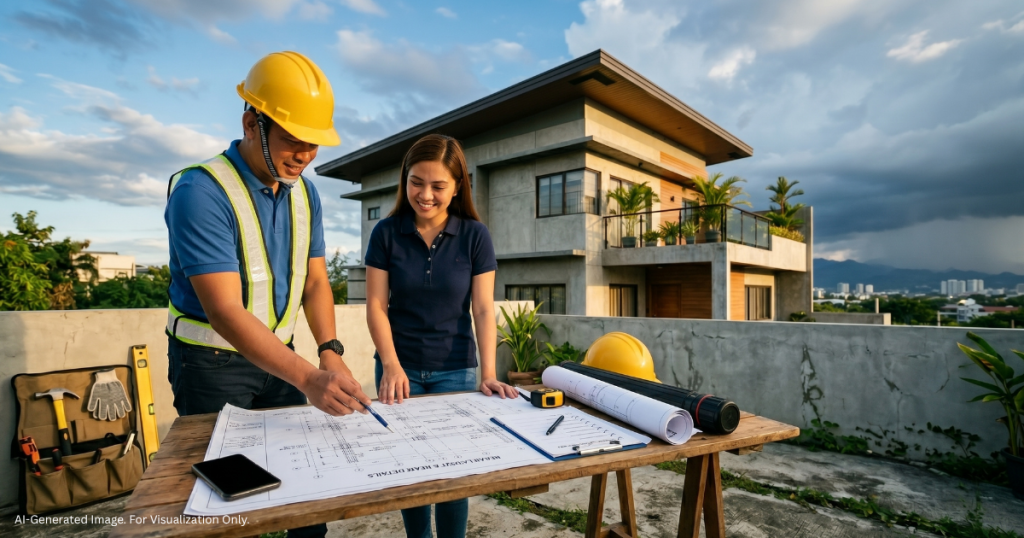
Protect your family and your hard-earned assets. When it comes to the structural integrity of your home, make the smart, proactive choice: turn off the screen, put down the DIY tools, and consult a licensed civil engineer. Building it right according to national code standards the first time is always infinitely cheaper than paying double to rebuild from a structural collapse.
Disclaimer
This article is intended for informational and educational purposes only. Structural modifications, engineering calculations, and building code compliance assessments require physical inspections and professional oversight. Property owners are strongly encouraged to consult licensed structural engineers and secure the appropriate permits from their local building officials before undertaking any structural construction or demolition.
References
Association of Structural Engineers of the Philippines (ASEP). (2025). Seismic design and structural standards for residential low-rise buildings. ASEP Publications. https://www.asep.org.ph/publications
Department of Public Works and Highways (DPWH). (2026). Standard specifications for public works and highway structures: Amendment series. DPWH Portal. https://www.dpwh.gov.ph/dpwh/references/guidelines_manuals
Office of the President of the Philippines. (1977, February 19). Presidential Decree No. 1096, s. 1977: Adopting a National Building Code of the Philippines. Official Gazette of the Republic of the Philippines. https://www.officialgazette.gov.ph/1977/02/19/presidential-decree-no-1096-s-1977/
Philippine Institute of Civil Engineers (PICE). (2025). Civil engineering code of ethics and professional practice standards. PICE Publications. https://www.pice.org.ph/pice-publications



 Facebook
 Instagram
 Linkedin
 Twitter
 Youtube
