

The Viral Debate on Job Automation vs. Tech Integration on Local Jobsites
“Mawawalan ba kami ng trabaho dahil sa AI?”
This is the question echoing across construction sites, design offices, and engineering schools in the Philippines today. As social media feeds fill with videos of automated bricklayers and AI generating fully detailed structural blueprints in seconds, a wave of anxiety has hit the local building sector. With the country’s infrastructure spending reaching historic highs, the pressure to deliver complex projects faster and under budget is forcing the industry to evolve.
However, the reality of 2026 is not about robots replacing human workers on-site. Instead, it is about digital construction systems quietly working behind the scenes to transform how we build.
For the modern Filipino builder, the threat is not the technology itself, but the refusal to adapt to a rapidly modernizing workforce.
Key Takeaways
- The Automation Reality: Artificial Intelligence is not a replacement for human craft but a powerful tool that eliminates tedious manual errors and speeds up project timelines.
- The Core 4 Technologies: AI-led estimation, generative design, automated drone flights, and predictive maintenance are the key pillars of modern smart sites.
- BIM Integration: Building Information Modeling (BIM) technology works hand-in-hand with intelligent platforms to protect project bottom lines during tight tropical building windows.
- The Ultimate Job Security: AI will not steal your construction job, but an engineering professional who knows how to use AI will inevitably replace one who does not.
1. The Core Four: AI Tools Modernizing Philippine Jobsites
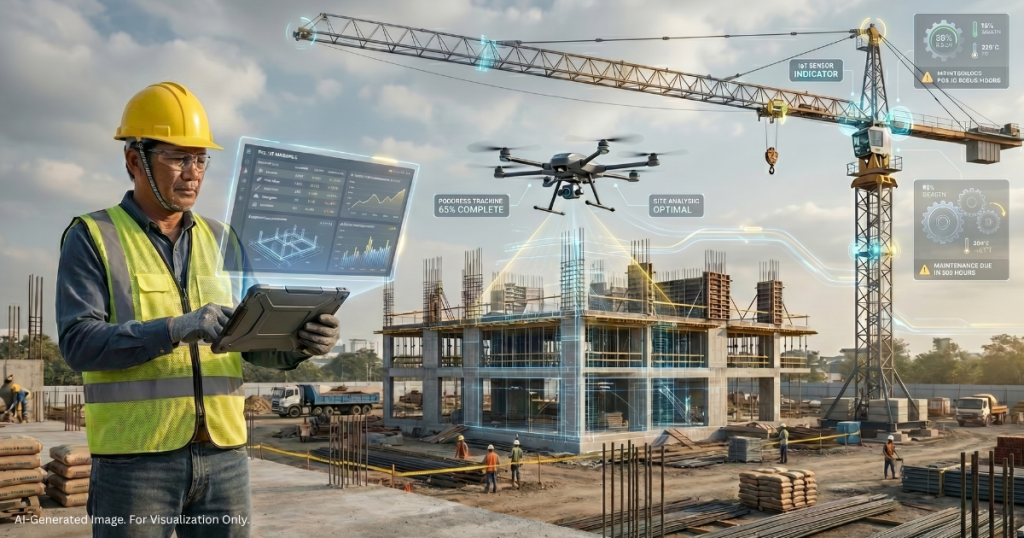
The shift toward construction technology is driven by the practical need to solve age-old jobsite headaches. Today, AI in construction is being deployed across four key disruptive areas to optimize productivity and reduce human error (Multico, 2026):
AI-Driven Material Cost Estimation
Manual quantity takeoffs can take days and are prone to double-ordering or under-budgeting. AI-led estimation software connects directly to your digital blueprints, instantly parsing dimensions and automatically generating highly accurate bills of materials (BOM). This prevents costly material waste before the first concrete truck even arrives.
Generative Architectural Design
Instead of starting from a blank canvas, designers can feed project parameters, such as lot area, budget constraints, wind loads, and solar orientation, into generative AI systems. The platform evaluates thousands of design permutations in minutes, delivering structurally optimized layouts that maximize space and comply with the National Building Code (PD 1096).
Drone Inspections and Progress Tracking
Large and hazardous sites no longer require workers to climb unsecured scaffolding for manual audits. Automated drone inspections use high-definition cameras and aerial mapping software to capture real-time 3D models of the site. AI algorithm layers analyze these images to instantly detect minute structural cracks, concrete voids, or rebar spacing deviations (Multico, 2026).
Predictive Maintenance Schedules
Heavy equipment downtime can stall a project for weeks. By attaching Internet of Things (IoT) sensors to excavators, cranes, and concrete mixers, AI models analyze performance data to forecast mechanical wear. The system alerts site managers of necessary repairs before a machine breaks down on the job, saving millions in emergency repair fees.
2. BIM and Smart Construction: The Invisible Framework
While concrete and steel remain the physical skeleton of our infrastructure, smart construction systems act as the invisible nervous system supporting the modern project lifecycle (Ramirez, 2026).
At the center of this revolution is BIM technology (Building Information Modeling). Far from being just “3D CAD,” BIM is a highly collaborative digital workflow. It allows architects, structural engineers, plumbers, and electrical contractors to work on a single, shared digital model of the building.
The Unified BIM Data Loop
- Upstream Design Inputs: Generative Architectural Design and AI-Driven Cost Estimation feed spatial dimensions and live material requirements into the shared model during pre-construction.
- The Coordination Core: The centralized BIM Model acts as a living, 3D database where engineering, plumbing, and structural layouts are cross-referenced to prevent “clash detection” errors.
- Downstream Progress Tracking: Real-Time Drone Audits continuously capture physical on-site progress, overlaying physical imagery directly onto the digital model, while embedded IoT Sensors transmit concrete curing metrics directly to the platform.
This integrated environment prevents critical spatial conflicts, such as a plumbing line running straight through a concrete structural beam. By resolving these conflicts digitally during pre-construction, builders can eliminate 30% of standard jobsite rework, protecting project bottom lines during short, high-stakes dry-season building windows.
Recognizing the global demand for these skills, institutions in the Philippines are rapidly upgrading their standards. In May 2026, a milestone master training program on BIM was launched by the Technical Education and Skills Development Authority (TESDA) and the Construction Manpower Development Foundation, backed by the International Labour Organization (ILO). This initiative is actively training a new generation of certified trainers to roll out digital construction skills nationwide, ensuring young Filipino builders remain competitive in both local and global labor markets (Mirage News, 2026).
3. The Mindset Shift: Adapting to Construction Automation
For many, the fear of construction automation stems from the belief that automated software will make human expertise obsolete. However, academic and practical studies in Metro Manila prove that AI’s greatest value lies in the implementation and monitoring phases, handling repetitive calculation tasks, predictive scheduling, and real-time risk alerts (Al-Aghbari et al., 2025).
AI lacks the human elements that are absolutely non-negotiable on a dynamic, high-stakes jobsite:
- Contextual Problem Solving: AI cannot negotiate with local suppliers when cement deliveries are delayed by typhoons.
- On-Site Leadership: Automated systems cannot manage team dynamics, resolve safety disputes, or coordinate hands-on trade teams.
- Creative Adaptation: Unexpected soil variations or structural surprises on-site require human intuition and decades of lived engineering experience.
Rather than fighting technology, local construction professionals must embrace upskilling. As the Philippine Constructors Association (PCA) recently emphasized, digital and green skills are the new currency of the global job market (Mirage News, 2026). Learning how to operate a drone, read a BIM model, or utilize AI-driven estimation platforms will guarantee your relevance and secure your spot on the modern site.
Conclusion: Partnering with the Future of Building
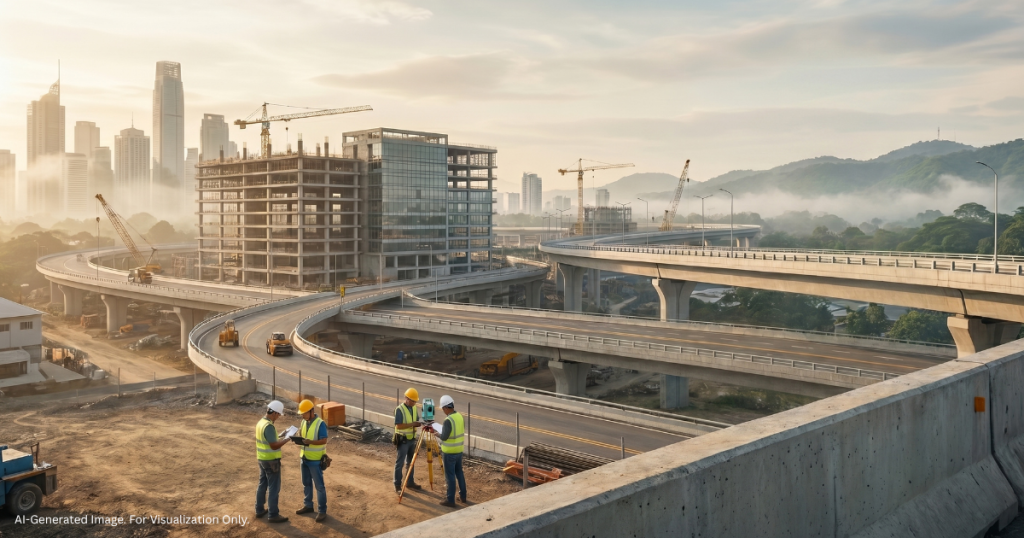
Technology is rewriting the rules of how we build in the Philippines. It is shifting the industry from slow, manual coordination toward high-precision, data-driven execution. The builders who thrive in this new era will be those who view these digital tools not as rivals, but as highly efficient partners.
Don’t wait for the future to render your old workflows obsolete. Upskill, adapt, and integrate digital tools into your building arsenal today. In the modern landscape, the ultimate blueprint for job security is simple: let AI handle the repetitive calculations so you can focus on building a safer, stronger, and more resilient nation.
Disclaimer
This article is intended for informational and educational purposes only. The integration of artificial intelligence, drones, and Building Information Modeling (BIM) systems involves highly specialized technical processes and varies depending on localized project specifications. Construction developers, engineers, and property owners are strongly encouraged to consult certified technology specialists and accredited BIM professionals to ensure compliance with local regulations and structural safety standards.
References
Al-Aghbari, M., et al. (2025). Assessment of Artificial Intelligence Applications in the Construction Life Cycle: Addressing Project Management Constraints in the Philippines. ResearchGate. https://www.researchgate.net/publication/391863420_Assessment_of_Artificial_Intelligence_Applications_in_the_Construction_Life_Cycle_Addressing_Project_Management_Constraints_in_the_Philippines
Mirage News. (2026, May 25). Philippines advances digital construction skills. https://www.miragenews.com/philippines-advances-digital-construction-skills-1679625/
Multico. (2026). Smart equipment: How technology is transforming construction in the Philippines. https://multico.com.ph/blog/how-technology-transforms-construction-philippines/
Ramirez, P. (2026, May 26). DANAOS Projects and the technology redefining construction. Daily Tribune. https://tribune.net.ph/2026/05/26/danaos-projects-and-the-technology-redefining-construction








 Facebook
 Instagram
 Linkedin
 Twitter
 Youtube
