
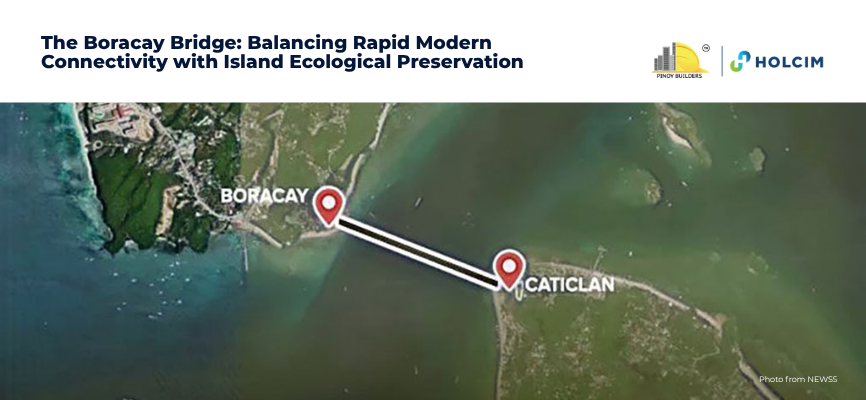
The Caticlan-Boracay Macro-Project Under the Environmental Microscope
For decades, the journey to Boracay Island, consistently ranked among the world’s most beautiful beaches, has followed a familiar, historic route. Travelers land in Caticlan, board traditional motorized outriggers or modern ferry boats, and cross the narrow Tablas Strait. However, this transit system could soon change permanently. The proposed Caticlan-Boracay Bridge, a multi-billion-peso macro-infrastructure project, aims to build a physical connection between mainland Aklan and the resort island.
While the project promises unprecedented economic growth, it has ignited a fierce public and environmental discourse. Proponents view the bridge as a vital logistical lifeline that will modernize transport and simplify basic utility services. On the other side of the debate, conservationists, local business coalitions, and marine biologists fear that physical connectivity could jeopardize the island’s fragile ecosystem, which is still recovering from its high-profile 2018 rehabilitation.
Evaluating this project requires a careful look at both sides. We must weigh the immediate logistical advantages against the strict ecological boundaries of one of the country’s most cherished natural treasures.
Key Takeaways
- The Debate on Connectivity: The proposed bridge between mainland Aklan and Boracay Island has divided local stakeholders, balancing economic modernization against ecological protection.
- Logistical Lifelines: A physical bridge would streamline supply chain transport, eliminate boat dependency during severe typhoons, and host integrated pipelines for clean water and solid waste disposal.
- Ecological Safeguards: Protecting marine life, preventing coastal soil erosion, and strictly managing Boracay’s tourist carrying capacity remain the primary roadblocks for developers.
- Green Engineering Solutions: Building in high-salinity marine environments demands low-emission, high-performance materials to minimize the carbon footprint while ensuring structural longevity.
1. The Logistics of Connection: Supply Chains and Lifelines
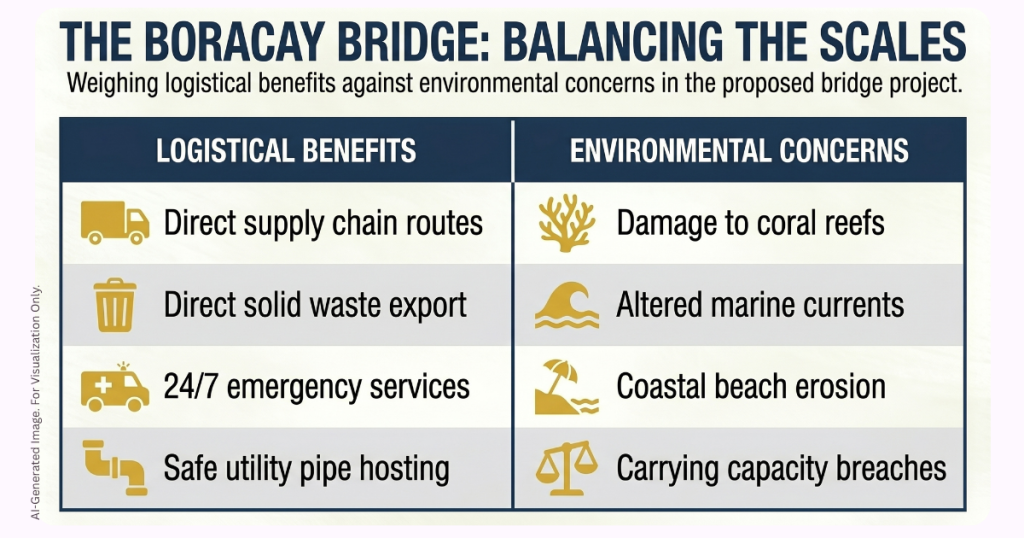
From a purely operational and economic standpoint, a physical bridge offers undeniable advantages for both the local community and the tourism sector (National Economic and Development Authority [NEDA], 2025). Connecting Boracay to the mainland solves several long-standing logistical pain points:
Seamless Supply Chain Transport
Currently, every piece of cargo, including fresh produce, construction materials, retail goods, and drinking water, must be manually loaded onto boats at the Caticlan jetty port and unloaded at the Boracay port. This double-handling significantly drives up the cost of living and doing business on the island. A bridge would allow supply trucks to drive directly to their destinations, stabilizing market prices and streamlining business operations.
Clean Utility Integration
One of the most valuable aspects of the proposed bridge design is its ability to carry physical utility lines. Instead of relying on vulnerable underwater cables and pipes, the bridge structure could safely house central fiber-optic internet lines, fresh water mains, and sewage pipelines. Crucially, it would make exporting solid waste and recyclables back to mainland sanitary landfills much easier and safer, preventing trash from building up on the island.
Disaster Resilience and Emergency Access
During the typhoon season, rough sea conditions frequently halt boat transport for hours or even days, leaving tourists stranded and isolating residents from emergency medical facilities. A bridge would guarantee a reliable, 24/7 evacuation route and provide immediate, uninterrupted access for emergency vehicles, fire trucks, and disaster response teams (Department of Public Works and Highways [DPWH], 2026).
2. The Ecological Ledger: Marine and Carrying Capacity Challenges
Despite these logistical benefits, environmental scientists and local preservation groups warn that the ecological cost of a physical bridge could outweigh its conveniences. Building a macro-infrastructure project across a marine strait presents deep ecological challenges (Department of Environment and Natural Resources [DENR], 2026):
Preserving Delicate Marine Ecosystems
The Tablas Strait is a highly active marine corridor home to thriving coral reef systems, seagrass beds, and diverse marine life. Constructing heavy concrete bridge pylons directly into the seabed disturbs the sea floor, causing massive sediment plumes that can smother nearby coral reefs and block vital sunlight. Engineers must design non-intrusive foundation systems to prevent irreversible damage to the marine habitat.
Mitigating Coastal Soil Erosion
Bridges alter the natural flow of marine currents. Placing solid barriers in a narrow strait can accelerate water velocity around the pylons, leading to severe seabed scouring and coastal soil erosion along Boracay’s famous white-sand beaches. Extensive hydrodynamic modeling is required to ensure the bridge design does not wash away the very sand that draws millions of tourists to the island.
Managing Tourist Carrying Capacity Thresholds
In 2018, scientific studies commissioned by the government capped Boracay’s strict tourist carrying capacity at approximately 19,215 tourists at any given time to protect the island’s infrastructure and ecosystems (DENR, 2026). Environmentalists fear that a bridge, by removing the natural “bottleneck” of boat transit, would lead to an unregulated influx of daily visitors and vehicles. This could overwhelm the island’s sewage, waste management, and freshwater systems, undoing years of environmental rehabilitation.
3. Green Engineering: Marine-Grade Materials for Sustainable Infrastructure
If the Boracay Bridge project is to move forward, it cannot rely on traditional construction methods. It must serve as a global model for green engineering by prioritizing low-emission, high-performance materials designed for harsh marine environments (PICE, 2025).
Marine environments are exceptionally brutal on concrete structures. The constant exposure to saltwater, airborne chlorides, and wet-dry cycles can cause moisture to penetrate traditional concrete, rusting the internal steel reinforcement and leading to cracking and structural decay.
To prevent this, the project must utilize advanced blended cements, such as slag-based or fly-ash cements (PICE, 2025). These innovative materials create a much denser, less porous concrete matrix that blocks chloride penetration, guaranteeing a long structural lifespan.
Crucially, utilizing low-carbon blended cement solutions dramatically reduces the carbon footprint of the massive concrete pours required for the bridge’s foundations. By combining these durable materials with strict traffic monitoring systems, such as banning private fossil-fuel cars and allowing only electric public shuttle transit across the bridge, the project can protect the island’s air quality while providing modern, durable infrastructure.
Conclusion: Engineering a Sustainable Compromise
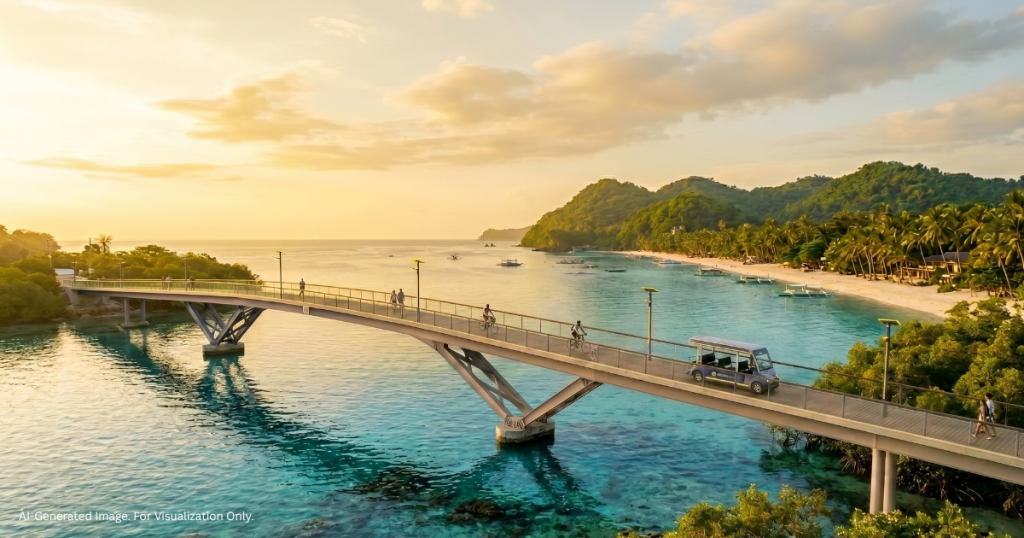
The debate surrounding the Boracay Bridge represents the classic global struggle between modern development and environmental preservation. It serves as a reminder that true progress is not measured solely by the speed of our transport or the size of our structures, but by our ability to coexist with the natural world.
For Boracay, a bridge can only be considered a success if it protects the island’s natural beauty. If developers prioritize green marine-grade materials, implement strict vehicle restrictions, and respect carrying capacity limits, this project could prove that modern infrastructure can actively support, rather than destroy, our country’s precious ecosystems.
References
Department of Environment and Natural Resources (DENR). (2026). Carrying capacity limits and environmental preservation guidelines for Boracay Island. DENR Portal. https://www.denr.gov.ph/index.php/news-events/
Department of Public Works and Highways (DPWH). (2026). Feasibility study updates and environmental impact guidelines for major coastal bridge networks. DPWH Portal. https://www.dpwh.gov.ph/dpwh/references/guidelines_manuals
National Economic and Development Authority (NEDA). (2025). Western Visayas regional development plan: Sustainable tourism and infrastructure connectivity framework. NEDA Portal. https://neda.gov.ph/regional-development-plans/
Philippine Institute of Civil Engineers (PICE). (2025). Sustainable infrastructure standards and green concrete technologies for marine construction. PICE Publications. https://www.pice.org.ph/pice-publications






 Facebook
 Instagram
 Linkedin
 Twitter
 Youtube
