
The Economic Drive Behind Adaptive Reuse
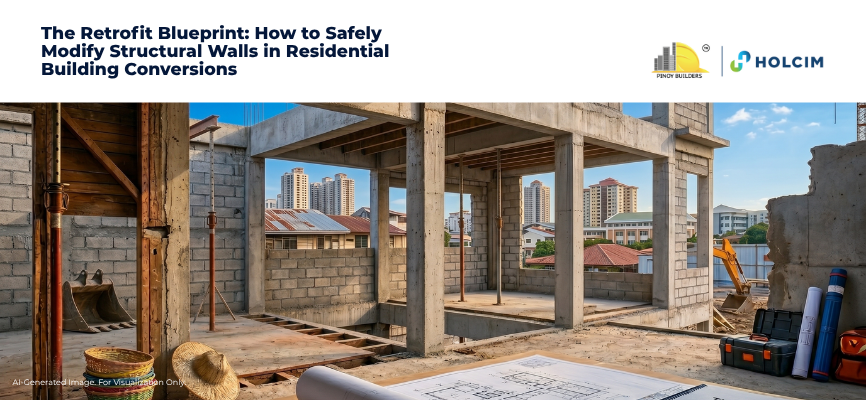
In the evolving urban landscape of Metro Manila and Cebu, homeowners are increasingly turning to adaptive reuse to monetize existing properties. Transforming a residential structure into a retail space or café is a high-growth trend; in fact, the Philippine Statistics Authority (PSA) reported a 7.5% increase in building permits for “additions and alterations” in late 2024, reflecting a surge in property conversions (PSA, 2024).
While this strategy is economically savvy, it often requires open-concept floor plans that demand the removal of existing walls. For small-scale contractors and DIY builders, the danger lies in misidentifying a partition wall as a load-bearing one. Modifying a structure without proper structural engineering oversight is a primary cause of building failure in the Philippines. As we move into 2026, the data shows that rectifying a structural collapse can cost up to 1,200% more than the initial cost of proper building retrofitting.
Key Takeaways
- Identification First: Verification of load-bearing status is mandatory; structural walls typically support 10% to 15% of the total building weight per floor.
- Load Transfer: Temporary shoring must support 1.5x the estimated dead load before any load-bearing wall removal begins.
- Material Precision: CFRP wraps can increase column load capacity by up to 30% without increasing the footprint.
- Code Compliance: Residential-to-commercial conversions must meet more stringent occupancy load requirements under PD 1096.
- Long-Term Value: Proper structural strengthening extends building life by 20–30 years.
Three High-Performance Tactics for Structural Strengthening
1. Steel Beam Installation and Sizing
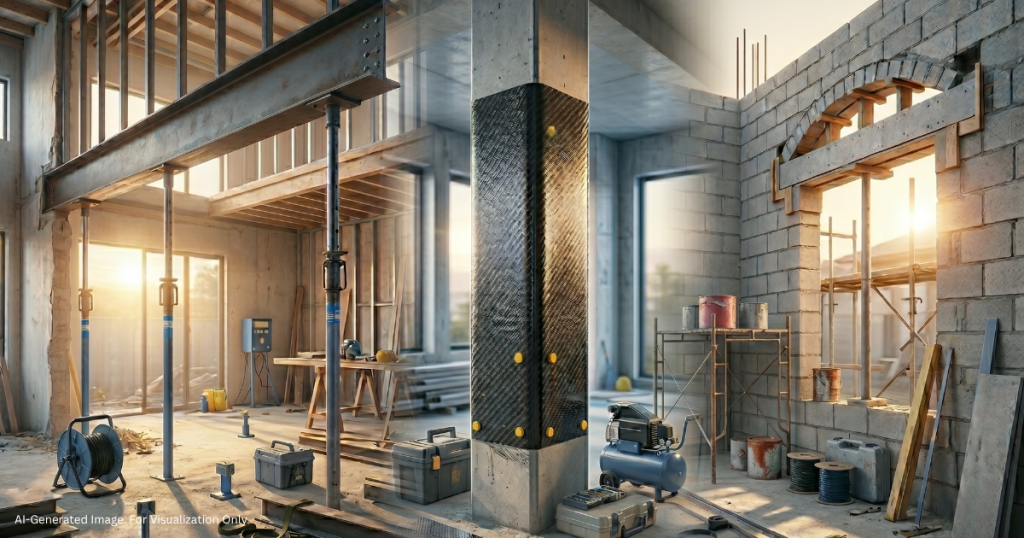
When a load-bearing wall is removed, a steel beam installation is required to bridge the gap. For a standard 3-meter opening in a residential structure, engineers often specify an I-beam or Wide Flange (WF) section. For preliminary estimation, the depth of the beam is typically calculated at 1 inch of depth for every 1.5 to 2 feet of span, though a licensed professional must always sign off on final sizing to account for seismic factors. Using structural steel ensures that the deflected load does not exceed 1/360th of the span, preventing unsightly ceiling cracks and maintaining building code compliance (DPWH, 2026).
2. Carbon Fiber Wraps (The 30% Strength Boost)
For residential conversion projects where existing columns must take on redistributed weight, Carbon Fiber Reinforced Polymer (CFRP) wraps are a game-changer. Engineering studies show that properly applied CFRP can increase the axial strength of a concrete column by approximately 30% while offering superior corrosion resistance in high-humidity Philippine environments. This is an ideal structural strengthening tactic for DIY builders who need high results with minimal structural bulk.
3. Jack-Arching and Reinforced Lintel Dynamics
For smaller modifications, such as adding a door or window to a structural wall, wall reinforcement through jack-arching, a method of creating a rigid, flat arch to distribute weight, or reinforced concrete lintels is necessary. A standard reinforced concrete lintel must have at least 150mm to 200mm of “bearing” (overlap) on the existing wall on either side of the opening to distribute the downward pressure and prevent masonry shear failure safely.
Technical Protocols: The Physics of Load Transfer
Before any demolition, a rigorous load-transfer protocol must be implemented. The most critical step is ensuring foundation support. A new steel beam concentrates thousands of kilograms of force onto two specific points; if the existing floor slab is only 100mm thick without an independent footing, the floor will crack or settle.
Engineers recommend a “Load-Path Analysis” to ensure that the weight of the roof and upper floors is successfully diverted to the ground. During the “open” phase of a retrofit, the building is at its most vulnerable. Temporary shoring posts should be spaced no more than 600mm to 900mm apart to ensure the ceiling does not sag during the transition.
Regulatory Hurdles: Meeting Building Code Compliance
Every residential conversion in the Philippines must legally transition from “Group A” (Residential) to “Group E” (Business and Mercantile) under the National Building Code (PD 1096). This shift effectively demands that the floor system handle over twice the weight, comparable to moving from a family dinner setting to a crowded retail floor, requiring a transition from 1.9 kPa for homes to 4.8 kPa for commercial use.
Achieving building code compliance means your structure is legally fit for public use. Failure to secure a Change of Use permit can result in fines starting at ₱10,000, but more importantly, it leaves the owner liable for any structural accidents. By following these professional retrofitting blueprints, you preserve the raw materials already in place while ensuring the safety of every future customer (DPWH, 2026).
Conclusion: The Bottom Line on Structural Safety
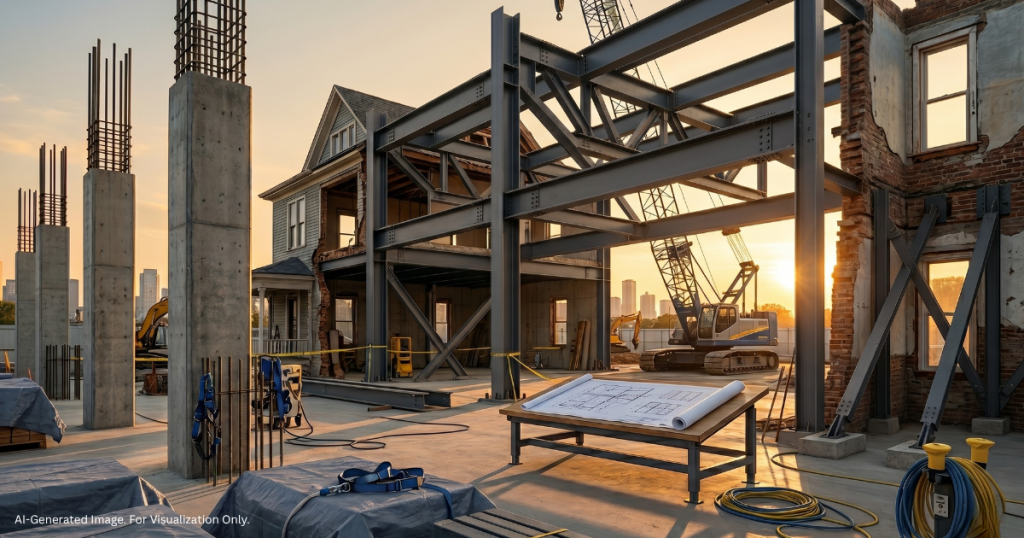
Converting a home into a business is an exciting milestone, but it must be built on a foundation of safety. Shortcuts in structural engineering lead to long-term liabilities that no business can afford. By using the right materials, such as high-strength reinforced cement concrete and precision-engineered steel, you ensure your conversion will stand strong for decades to come.
In 2026, building smarter means respecting the bones of the building while ensuring they can handle a new vision. Before you pick up the sledgehammer, consult a licensed engineer to turn your retrofit blueprint into a reality.
References
Department of Public Works and Highways. (2026). Department Orders and Issuances on Building Retrofitting and Structural Standards. Dpwh.gov.ph. https://www.dpwh.gov.ph/dpwh/references/issuances/department_order
Philippine Information Agency (PIA). (2026). DPWH pushes transparent infrastructure spending under 2026 budget. Pia.gov.ph. https://pia.gov.ph/news/dpwh-pushes-transparent-infrastructure-spending-under-2026-budget/
Philippine Statistics Authority. (2024). Construction Statistics from Approved Building Permits Philippines 2024. Psa.gov.ph. https://psa.gov.ph/content/construction-statistics-approved-building-permits-philippines-2024








 Facebook
 Instagram
 Linkedin
 Twitter
 Youtube
