
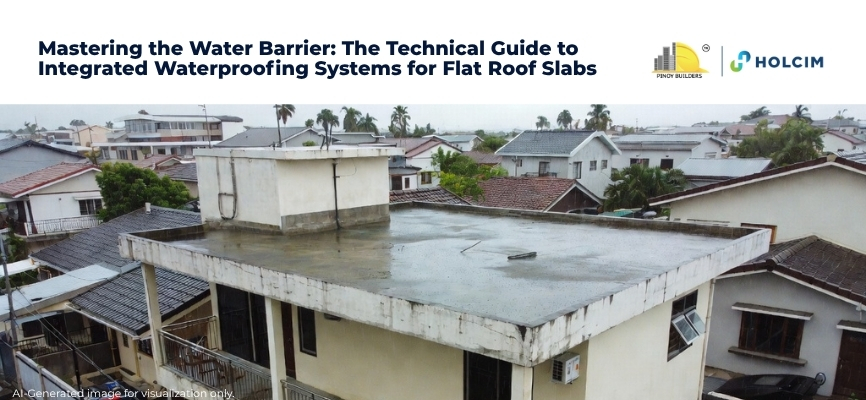
In the Philippines, where typhoons and prolonged monsoon rains are a yearly reality, these small design oversights can quickly become major structural problems. For structural engineers and architects, this climate presents severe engineering challenges, particularly when protecting flat concrete roof decks and balconies from pooling water. During Holcim’s July technical interview, structural engineers noted that the majority of roof deck leaks they encounter are not caused by membrane failure, but by poor drainage design and inadequate detailing around penetrations. Failure to properly execute flat roof waterproofing in such extreme weather can compromise interior habitability and lead to accelerated structural degradation.
Key Takeaways
- Climate-Driven Necessity: The extreme Philippine climate requires advanced roof deck waterproofing to protect flat concrete slabs from typhoon-driven rains and prevent structural degradation.
- Material Selection: Understanding the chemical and molecular differences between crystalline, liquid-applied, and cementitious barriers (like Holcim Tector Proof) is crucial for creating a durable, integrated waterproofing membrane.
- Crucial Geometry: A high-performance material must be paired with strict slope-to-drain engineering (1.5% to 2% minimum) and precise expansion joint waterproofing to prevent water ponding and subsequent rebar corrosion.
- Mandatory Validation: A rigorous 24-to-48-hour flood test is an absolute requirement before applying final finishes to guarantee the integrity of all flat roof waterproofing systems.
The Science of the Shield: Material Differences in Waterproofing
Achieving effective concrete slab waterproofing requires a deep understanding of material science. Modern engineering relies on three primary types of barriers to protect concrete substrates: crystalline, liquid-applied, and cementitious systems.
Crystalline waterproofing relies on active chemical formulations that penetrate the porous concrete matrix. When exposed to moisture and free lime, these chemicals react to form insoluble crystals that permanently block capillaries and micro-cracks against water ingress (American Concrete Institute [ACI], 2013). On many failed roof deck inspections, liquid-applied membranes remain intact, but water has already found a path through an improperly sealed expansion joint. The membrane wasn’t the problem—the detailing was.
Conversely, cementitious waterproofing barriers, such as Holcim Tector Proof, are engineered for maximum compatibility with the concrete itself. Because they share a similar chemical composition with the substrate, cementitious materials bond on a molecular level. This reaction forms a seamless, integrated waterproofing membrane that provides a durable waterproofing layer, effectively shielding the concrete from both positive and negative hydrostatic pressure.
Engineering for Flow: Slope-to-Drain and Joint Detailing
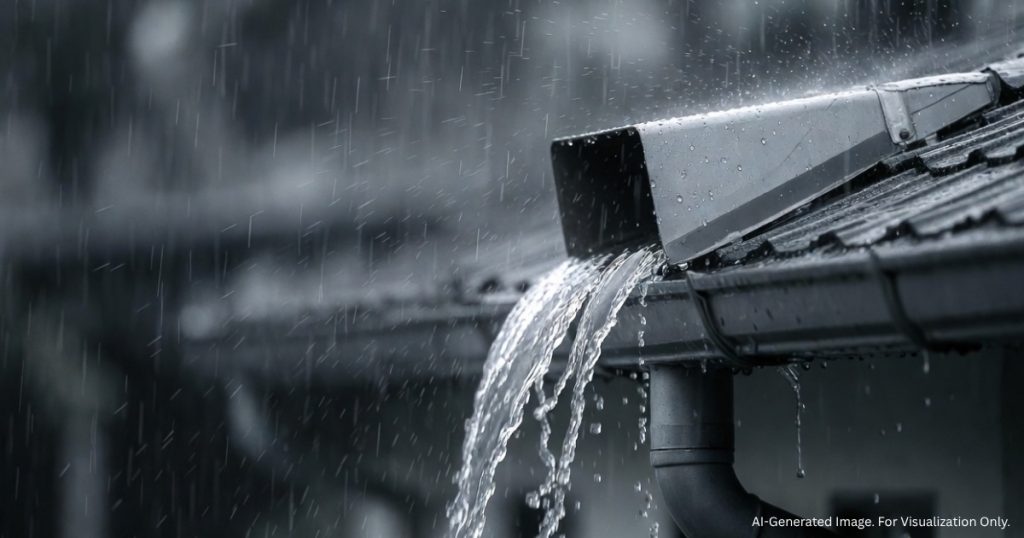
Selecting a high-performance material is only one component of a successful defense against moisture; architectural geometry is equally vital. Even the most advanced flat roof waterproofing systems will eventually succumb if subjected to continuous water ponding.
Experts emphasize the critical role of slope-to-drain engineering. The National Building Code of the Philippines (NBCP) dictates appropriate sloping to ensure runoff, generally recommending a minimum slope of 1.5% to 2% to guide water rapidly toward scuppers and drainage points (Department of Public Works and Highways [DPWH], 2005).
The Importance of Correct Joint Detailing
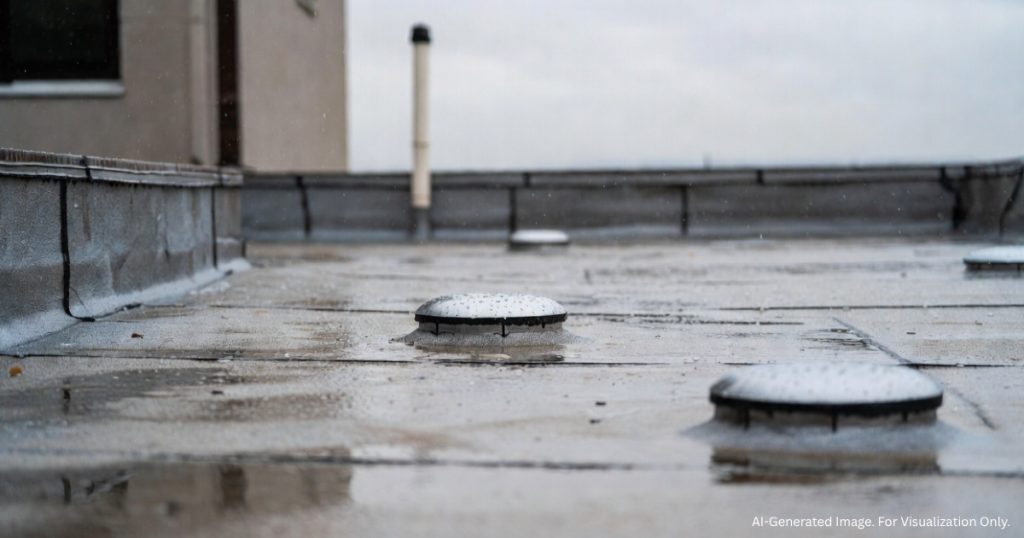
Furthermore, flat roof systems are highly vulnerable at their transitions. Correct joint detailing at parapet walls is non-negotiable. Without meticulous expansion joint waterproofing and the installation of proper cants or fillets at 90-degree transitions, water will inevitably collect. Once pooling occurs at these weak points, moisture can easily bypass the membrane, seeping into structural columns and causing severe rebar corrosion, a fatal flaw for building longevity.
The Ultimate Verification: Flood Testing
Theoretical engineering must always be validated by physical testing. Before the application of any final tile adhesives, protective screeds, or wearing courses, it is an absolute necessity to conduct a flood test.
Under strict engineering supervision, drains are temporarily plugged, and the waterproofed deck is flooded with 1 to 2 inches of water for 24 to 48 hours (ASTM International, 2019). This critical quality assurance test guarantees that the waterproofing membrane and all edge details are perfectly sealed. Bypassing this step risks concealing a leak beneath a finished floor, transforming a simple fix into a catastrophic and expensive structural repair.
Conclusion
Navigating the severe tropical climate of the Philippines requires a proactive, scientifically sound approach to building maintenance and design. By selecting the correct materials, such as deeply bonded cementitious systems, executing precise slope-to-drain engineering, and refusing to bypass the crucial flood testing phase, professionals can guarantee the integrity of their structures. Ultimately, mastering these core waterproofing elements transforms a vulnerable concrete slab into an engineered waterproofing system, securing the building’s longevity against the harshest monsoon seasons.
References
American Concrete Institute. (2013). Guide to selecting protective treatments for concrete (ACI 515.2R-13). https://www.concrete.org/
ASTM International. (2019). Standard guide for testing watertightness of waterproofing installations on horizontal liquid-applied waterproofing membranes (ASTM D5957-98(2013)e1). https://doi.org/10.1520/D5957-98R13E01
Department of Public Works and Highways. (2005). The National Building Code of the Philippines and its revised implementing rules and regulations. Republic of the Philippines.
Philippine Atmospheric, Geophysical and Astronomical Services Administration. (2023). Climate of the Philippines. Department of Science and Technology. https://www.pagasa.dost.gov.ph/information/climate-philippines






 Facebook
 Instagram
 Linkedin
 Twitter
 Youtube
