
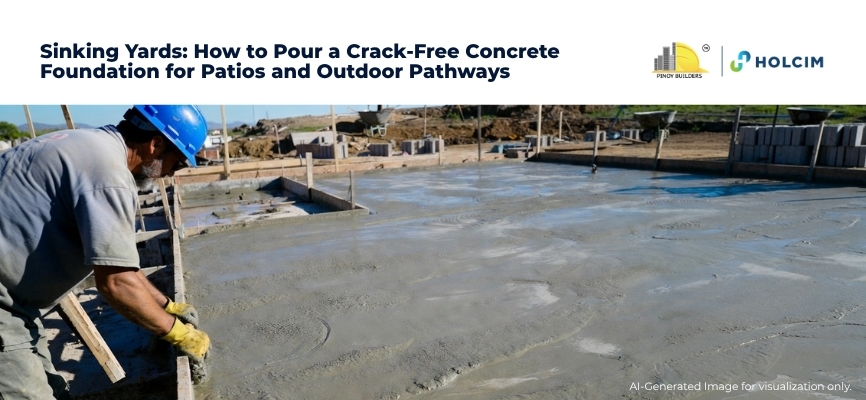
A Comprehensive Concrete Foundation Guide
The Rush Before the Monsoon Season for June’s theme of Outdoor & Landscaping Foundations, many homeowners rush to complete their patio construction and outdoor pathway projects before the heavy monsoon rains arrive. Unfortunately, this rush often leads to critical missteps during foundation preparation. A poorly constructed foundation quickly results in a “sinking yard”, a disastrous scenario where concrete slabs crack, heave, or settle unevenly after the very first major storm of the wet season.
While concrete pouring might look like a straightforward weekend task, ensuring your outdoor living spaces survive the wet season requires careful planning. By understanding the engineering science behind concrete placement, DIY builders can avoid common pitfalls and create durable, crack-free surfaces.
Key Takeaways
- Mandatory Foundation Preparation: A successful pour requires rigorous soil compaction, building robust timber formwork, and laying a solid gravel base to ensure proper drainage.
- The Science of Concrete Performance: Concrete is highly susceptible to moisture scaling and tension stress; managing its permeability is essential to a long-lasting slab.
- Specialized Tropical Cement: A low-permeability, specialized tropical cement (like Holcim Solido) is required to resist cracking and shifting under changing soil conditions.
- Wet-Season Curing Protocol: Step-by-step tenting and curing strategies protect your newly poured patio installation from being washed away or weakened by unexpected heavy downpours.
1. The Groundwork: Crucial Foundation Preparation Phases
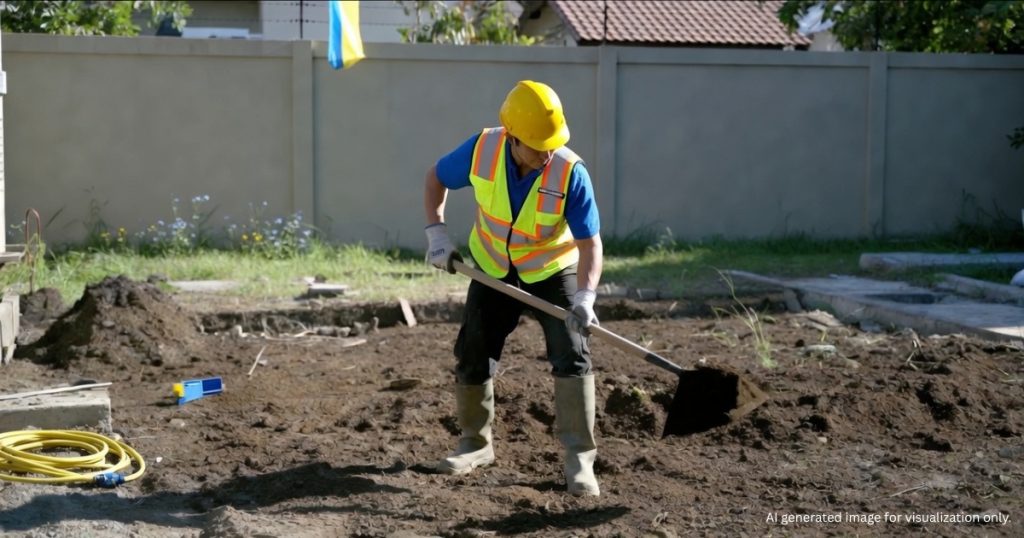
To pour a foundation that will not sink or crack, builders must focus heavily on the base. The most common mistake DIY builders make is beginning their concrete pouring directly onto uncompacted topsoil. When the earth beneath settles unevenly, the concrete will bend under its own weight and inevitably crack (Mindess et al., 2004).
Proper Soil Compaction Before pouring, all organic topsoil must be removed to reach a stable subgrade layer. The Portland Cement Association (PCA, 2021) recommends using a mechanical plate compactor to achieve uniform soil compaction. If the soil is too dry, it will not compact properly, and if it is too wet, it will turn to mud.
Laying a Solid Gravel Base After compacting the subgrade, adding a granular subbase of crushed gravel is critical. This layer provides a flat, load-bearing surface and breaks the capillary action of groundwater. Without it, moisture from the soil will wick directly into the concrete, leading to long-term deterioration (Kosmatka & Wilson, 2011).
Building Robust Timber Formwork The formwork dictates the final shape and structural integrity of the slab’s edges. Use robust timber secured tightly with stakes. Furthermore, ensure your formwork incorporates a slight slope, typically ¼ inch per foot, to guarantee proper water drainage away from your home’s main foundation (PCA, 2021).
2. The Engineering Science of Concrete Performance
Not all concrete mixtures are created equal, especially in regions subject to intense tropical downpours. The key to a crack-free slab lies in managing permeability and shrinkage.
Moisture Scaling and Shifting Soils Concrete is essentially a rigid sponge. When water penetrates an earth-contact outdoor slab, it causes internal expansion and contraction as temperatures change, leading to surface flaking known as moisture scaling. Ground moisture combined with heavy rain creates a highly aggressive environment (Mindess et al., 2004).
The Necessity of Specialized Tropical Cement To combat these environmental stressors, engineering standards dictate the use of low-permeability cement. Standard Portland cement is often too porous for harsh tropical weather. Specialized blended cements, such as Holcim Solido, are highly recommended because they refine the pore structure of the concrete, significantly reducing water absorption (Holcim Philippines, n.d.). This makes the foundation highly resistant to moisture ingress and shifting under changing soil conditions.
3. The Wet-Season Curing Protocol
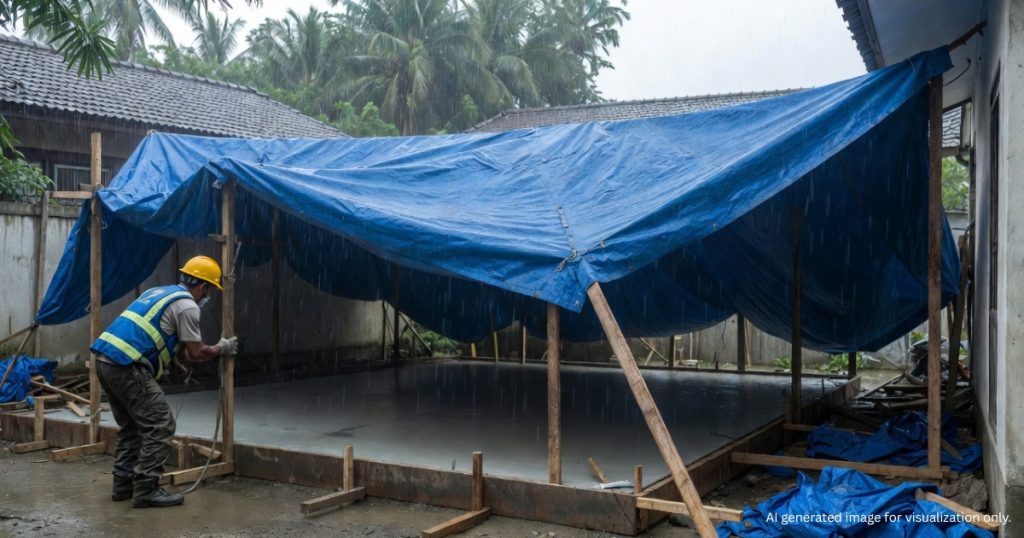
Executing a patio installation right before or during the monsoon season carries the immense risk of having your freshly poured slab ruined by an unexpected heavy downpour. If rain hits wet concrete, it can wash away the surface cement paste, leaving a weakened, sandy finish exposed to the elements (American Concrete Institute [ACI], 2016).
Timing and Tenting Strategies Never begin a pour if heavy rain is imminent. Before mixing, prepare heavy-duty waterproof tarps and extra timber. If an unexpected downpour begins, do not lay plastic directly onto the wet concrete, as this traps uneven surface water. Instead, build a quick “tent” using your extra timber to suspend the plastic sheeting above the slab, ensuring the edges overhang the formwork to direct runoff away from the subgrade (ACI, 2016).
Controlled Moisture Curing Concrete cures through a chemical reaction called hydration, which requires moisture (PCA, 2021). Once the rain passes and the concrete reaches its final set, lower the plastic to rest directly on the hardened slab. This traps internal moisture, allowing the specialized cement to cure slowly and reach its maximum compressive strength.
Conclusion: Anchoring Your Outdoor Living Spaces
By focusing on rigorous foundation preparation, embracing the engineering science of specialized low-permeability cements, and prioritizing a strict wet-season curing protocol, any DIY builder can successfully construct a durable patio or outdoor pathway. True foundational strength comes from understanding how your materials interact with the environment, ensuring your patio construction survives the heavy rains and lasts for decades.

References
American Concrete Institute (ACI). (2016). Guide to external curing of concrete (ACI 308R-16). Farmington Hills, MI: American Concrete Institute. Available at: https://www.concrete.org/store/productdetail.aspx?ItemID=30816
Holcim Philippines. (n.d.). Holcim Solido: Premium blended cement. Available at: https://www.holcim.ph/
Kosmatka, S. H., & Wilson, M. L. (2011). Design and control of concrete mixtures (15th ed.). Portland Cement Association. Available at: https://www.cement.org/learn/concrete-technology/concrete-design-production
Mindess, S., Young, J. F., & Darwin, D. (2004). Concrete (2nd ed.). Prentice Hall.
Portland Cement Association (PCA). (2021). Design and control of concrete mixtures (17th ed.). Portland Cement Association. Available at: https://www.cement.org/





 Facebook
 Instagram
 Linkedin
 Twitter
 Youtube
