
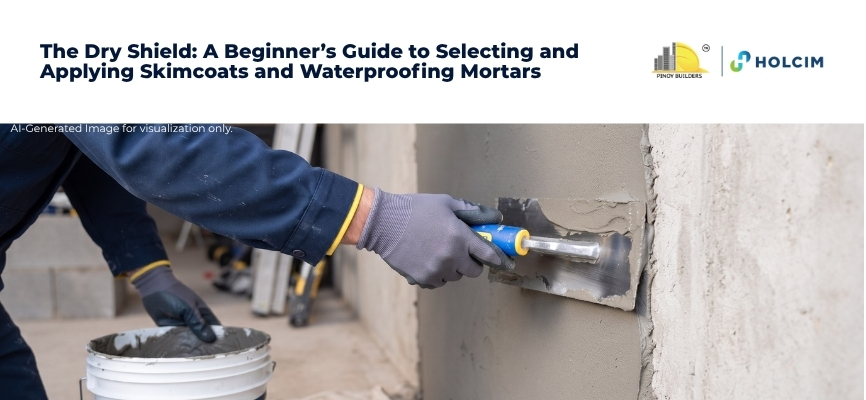
A Comprehensive Masonry Finishing Guide
For July’s theme of The Leak-Proof Home, local DIYers are in a frantic race against time to seal their exterior concrete masonry before the heavy monsoon season reaches its peak. Unfortunately, applying skimcoats and waterproofing layers in a rush often leads to disastrous results, such as blistering paint, peeling surfaces, and severe indoor dampness. While finishing a wall might seem like a simple weekend project, ensuring your masonry can withstand relentless torrential rains requires meticulous preparation and the right materials. By understanding the science behind modern waterproofing systems, DIY builders can create a formidable barrier against the elements.
Key Takeaways
- Mandatory Wall Preparation: A flawless finish begins with rigorous surface cleaning, knowing how to fix cracked concrete walls, and properly dampening the substrate to ensure a secure bond.
- The Science of Waterproofing: Advanced polymer-modified skimcoats and cementitious waterproofing block liquid water while allowing essential water vapor to escape. If you are wondering to yourself: “What is a skimcoat designed to do in extreme weather?” It is primarily this dual function.
- Specialized Mortars: High-performance wall leveling compound and specialized mortars (like Holcim Tector) are essential for creating a durable, leak-proof shield that fills concrete micropores.
- Wet-Season Application Protocol: Step-by-step humidity management and learning exactly how to apply skimcoat with correct layering techniques ensures your coating cures properly, resulting in a paint-ready finish that resists peeling.
1. The Groundwork: Critical Preparation Phases for Masonry Walls
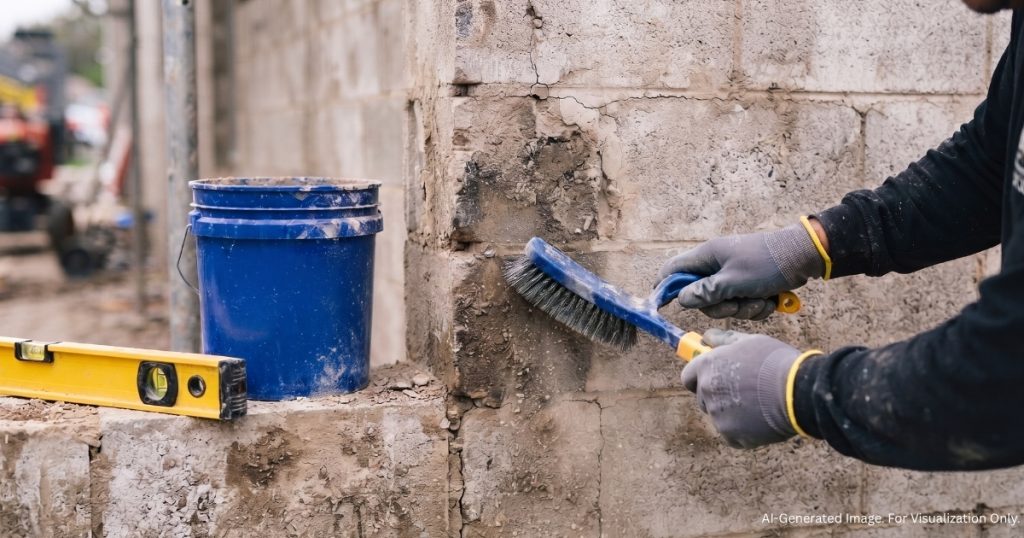
Before applying any protective layer, builders must focus entirely on preparing the bare wall. The most frequent error DIYers make is applying a wall skim coat directly over dusty, dry, or cracked concrete blocks, which guarantees an eventual failure of the waterproofing system.
Thorough Surface Cleaning
Before application, the masonry surface must be entirely free of dust, dirt, grease, and loose particles. Any organic material or debris will act as a bond-breaker, preventing the mortar from adhering properly to the concrete block (American Concrete Institute [ACI], 2020). Use a stiff wire brush and high-pressure water to thoroughly clear the surface.
Filling Hairline Cracks
Structural integrity must be established before waterproofing begins. Inspect the wall for hairline cracks and patch them with a suitable repair mortar. Leaving cracks exposed guarantees that hydrostatic pressure will eventually force rainwater behind your finish layer, leading to bubbling and delamination (Portland Cement Association [PCA], 2021). Understanding how to fix cracked concrete walls before moving forward is non-negotiable.
Dampening the Concrete Substrate
One of the biggest mistakes first-time DIYers make is applying a skimcoat on a dry concrete wall. Within minutes, the wall absorbs the mix’s moisture, making the skimcoat difficult to spread and increasing the risk of shrinkage cracks later. If the wall is too dry, it will suck the hydration water out of the newly applied skimcoat too quickly, causing premature drying, weak bonding, and severe shrinkage cracks (Kosmatka & Wilson, 2011).
2. The Engineering Science of Polymer-Modified Skimcoats
Not all finishing plasters can withstand the relentless driving rain of the monsoon season. True exterior protection requires a fundamental understanding of how advanced mortars interact with both liquid water and humidity, especially when debating skimcoat vs plaster.
Vapor Permeability vs. Water Resistance
Standard concrete walls act like rigid sponges during heavy downpours. A modern cementitious waterproofing system must perform a vital dual function: it must block liquid water from entering from the outside, while remaining vapor-permeable to allow trapped internal moisture to escape. If a coating traps moisture vapor inside the wall, the resulting pressure will eventually cause the exterior paint to blister and peel off entirely (Building Science Corporation, 2007).
The Advantage of Specialized Mortars
To achieve this delicate balance, engineering standards strongly recommend polymer-modified skimcoats. These specialized products contain powdered polymers that improve flexibility, adhesion, and water resistance, which is a key difference when considering skimcoat vs plaster. Using a specialized mortar, such as Holcim Tector, provides a highly engineered, ultra-thin finishing layer that acts as an advanced wall leveling compound, filling the micropores of the concrete block (Holcim Philippines, n.d.). This creates a dense, impenetrable shield against monsoon rains while allowing the building substrate to safely “breathe.” While the initial price of skim coat variants with polymer modifications might be slightly higher than standard plaster, the long-term durability pays for itself.
3. The Wet-Season Application Protocol
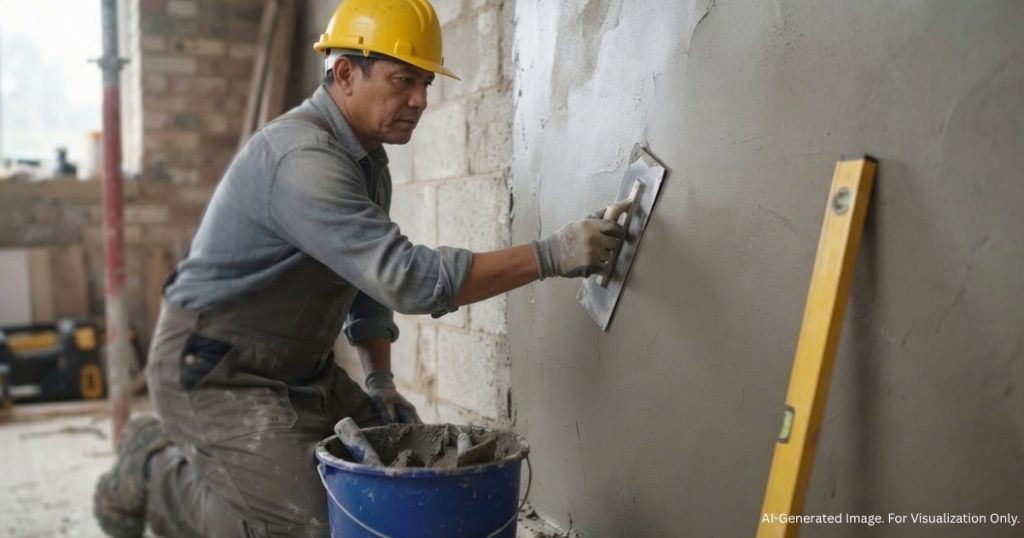
Applying skimcoats and waterproofing mortars during high-humidity, wet-season conditions requires strict adherence to curing and application protocols to ensure a flawless, paint-ready finish.
Layering and Thickness Control
Never attempt to apply a thick layer of skimcoat all at once. Applying layers thicker than 2 to 3 millimeters per coat traps moisture and invites sagging and map-cracking. Apply the material in thin, even coats using a steel trowel. Allow the first coat to set partially before applying the next, ensuring a smooth, dense finish that actively resists ambient dampness (ACI, 2020).
Managing Humidity and Rain Protection
While cementitious waterproofing needs moisture to hydrate properly, a direct rainstorm will wash away the active polymers before they cure. Keep heavy-duty waterproof tarpaulins ready to shield newly coated walls from sudden downpours. Take advantage of the high ambient humidity of the wet season by tenting the wall; this actually aids in the slow hydration of the cement mortar, resulting in a stronger, denser finish that is perfectly prepared for exterior paint (Kosmatka & Wilson, 2011).
Conclusion: Securing Your Home’s Exterior Shield
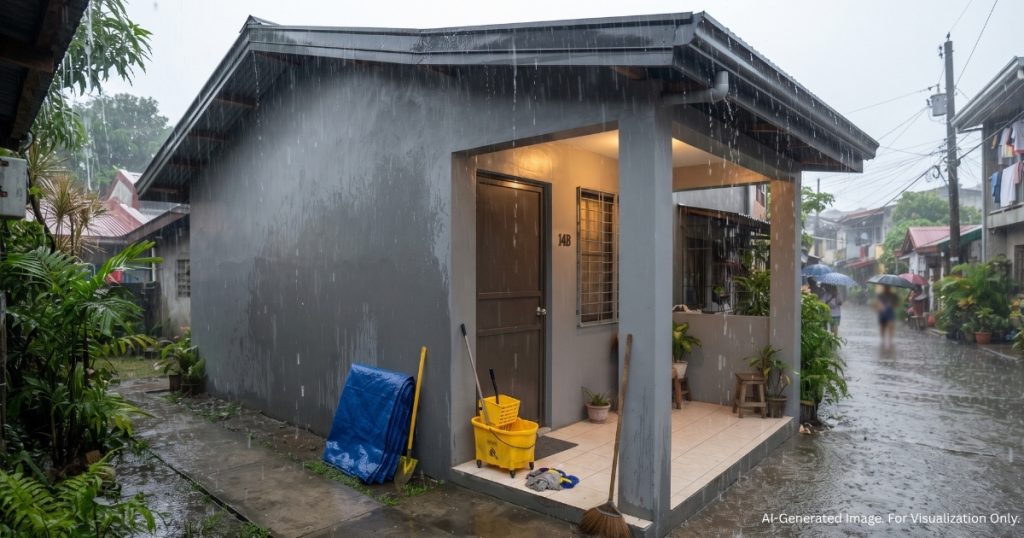
By executing rigorous wall preparation, leveraging the engineering science behind polymer-modified skimcoats like Holcim Tector, and following a strict wet-season application protocol, DIY builders can transform porous concrete blocks into an impenetrable barrier. While you must consider factors like the price of skim coat products for your budget, a truly leak-proof home begins at the surface, ensuring that your exterior walls remain smooth, durable, and completely dry through the harshest monsoon storms.
References
- American Concrete Institute (ACI). (2020). Guide to Portland Cement-Based Plaster (ACI 524R-16). Farmington Hills, MI: American Concrete Institute. Available at: https://www.concrete.org/
- Building Science Corporation. (2007). Understanding Vapor Barriers (BSD-106). Westford, MA. Available at: https://buildingscience.com/documents/digests/bsd-106-understanding-vapor-barriers
- Holcim Philippines. (n.d.). Holcim Tector: Finishing Solutions. Available at: https://www.holcim.ph/
- Kosmatka, S. H., & Wilson, M. L. (2011). Design and control of concrete mixtures (15th ed.). Portland Cement Association. Available at: https://www.researchgate.net/publication/348676262_Design_and_Control_of_Concrete_Mixtures
- Portland Cement Association (PCA). (2021). Design and control of concrete mixtures (17th ed.). Portland Cement Association. Available at: https://www.cement.org/




 Facebook
 Instagram
 Linkedin
 Twitter
 Youtube
